
Common Kanban Implementation Mistakes

Why Kanban implementations fail?
While using Kanban helps teams control the volume of work in progress and improve the flow of tasks between request and delivery, these benefits do not automatically follow the introduction of a visual board. Poor replication of the team’s real workflow, inconsistent practices, misread metrics, and inadequate managerial habits are just a few culprits of limited Kanban success.
To make your team’s Kanban journey a triumph, it’s worth becoming aware of common implementation pitfalls, as well as their symptoms and, of course, potential remedies.
1. Board design & setup
Mistake 1: Treating the board as just a list
The symptom: The Kanban board merely serves to record tasks to do and done, but is irrelevant to how work moves through the process.
This happens when a team is focused on organizing its workload, not so much on understanding it. A conventional task list limits to what needs doing, a Kanban system adds to that a visualization of where tasks are waiting or blocked, and what are the next steps for each item.
It means taking a more detailed approach to work status display; e.g., rather than showing an item sitting in a generic Doing column, a software team slides it through Verifying requirements → Gathering information → Coding → Testing → Final review → Ready to deploy stages, at all times making it clear to everyone how far along a task is. If a task gets blocked along the way, the reason behind it should be made explicit on the task itself, and the party able to unblock it should be contacted or assigned to the task.
The fix:
Map the real-life flow of tasks in your unique system, from the initial request to delivery. Identify all of the meaningful steps, including review steps and known waiting stages affecting completion. Meaningful steps are those that support or clarify decision points.
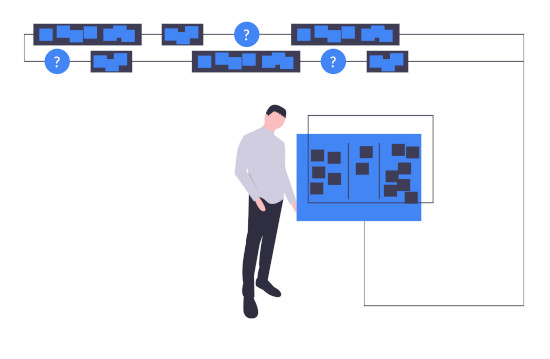
Mistake 2: Overcomplicating the board
The symptom: The board is hard to grasp, tasks sit in unnecessary intermediate stages, and maintaining the board becomes a job in its own right, stealing time from actual delivery work.
As you can imagine, this problem can easily occur while remedying the previous one, with a column added for every little change in activity, e.g., for opening a pull request, assigning a reviewer, conducting an initial review, requesting changes, approving the changes, merging the code, preparing a release, etc. While some of these distinctions may be valuable, most add little to no insight - they aren’t signaling a queue, a handoff, nor a decision. They’re only adding work.
The fix:
Start your board as the simplest representation of your process, in a way that supports easy coordination. Only expand it with a column, swimlane, or policy when there is a reason; for example, where there’s a repeating delay, a clear responsibility change, or a fragile point requiring special attention.
A rule of thumb is that if a proposed alteration does not reflect a change in the team’s understanding and/or management of work, it’s unnecessary.
Mistake 3: Failing to signal column meaning
The symptom: Team members have varied opinions on when a task is still in progress, ready for review, or completely done.
Sometimes, the meaning behind board columns stems from the workflow understanding of the person who designed it. But different team members may not share those assumptions and move tasks across the board on the basis of their own beliefs.
For example, where a developer moves a card to Code Review to generally signal that a review is needed, a reviewer may treat that column as showing tasks already accepted by a specific reviewer, so as tasks already being examined.
The fix:
Determine entry and exit criteria for key workflow stages, specifying what conditions must be met before a card can enter or leave each column. Doing so reduces ambiguity and increases the board’s ability to represent work reliably.

2. Daily execution
The validity of a Kanban system heavily depends on how the team uses it, since even a well-designed board yields little benefit if people begin work indiscriminately of WIP limits, ignore blocked tasks, reset priorities, or disregard clearly stated process rules.
Mistake 4: Ignoring WIP limits
The symptom: Everyone on the team seems busy, but very few tasks reach completion.
Work-in-progress (WIP) limits restrict the number of tasks started in a particular stage at one time, allowing the team to avoid spreading its attention across more items than it can reasonably process. Without task limits, people have a tendency to pick up new tasks whenever possible, and beginning each new task comes with context-switching-related waste, not to mention increasing the volume of unfinished work. It’s wasteful because tasks are only valuable when shippable/done at a predictable pace; it’s better to deliver 4 tasks a week than to have started work on 12 and completed none.
The fix:
Introduce and enforce realistic WIP limits, based on the team’s capacity and past flow tendencies. Depending on circumstances, limits may apply to individual columns, or a broader process section.
When a limit is met, the desired response is for all available team members to help advance open work, remove impediments, or take other actions allowing for clearing the overloaded stage.
Exceeding the limit may be justified only if explicit, agreed-upon conditions are met. The bottom line of using WIP limits is flow management, not sticking to an arbitrary value at any cost. Leaving slack in the system is also important.

Mistake 5: Overlooking blocked tasks
The symptom: Tasks sit in the same stage for days, regardless of whether the block reason can or cannot be determined.
A portion of any team’s work will always pause due to a dependency on someone else’s decision, incomplete information, an unavailable specialist, technical issues, etc. That’s normal and unavoidable; the real, costly problem is when the team cannot tell blocked tasks from those that are progressing, albeit slowly.
The fix:
Clearly distinguish blocked tasks on the board and note the blockage reason, along with identifying the designated person to resolve it, and ideally also setting a follow-up date.
It’s not so much that the responsible team member must fix the problem themselves, but it’s their role to ensure the impediment receives attention, and that a path to resolution is visibly mapped. Blockers that repeat regularly are a different story, deserving extra investigation. When the same process step gets delayed over and over, it could mean you need to reorganize that part of the process rather than keep rescuing individual tasks.
Did you know?
Digital Kanban Tool® boards allow teams to visibly differentiate blocked tasks from all the others, making it clear where extra attention is required. Team members can also set up reminders to check-in with individual blocked items, ensuring that nothing slips through the cracks. Try these, and many other clever features, together with your team!
Mistake 6: Failing to finish tasks
The symptom: Team members regularly pull new tasks when others remain unfinished.
Completing a task often demands cooperation, waiting for comments, and - worse of all - addressing issues we’d rather avoid. As a result, team members may keep adding new work while their existing commitments are close to completion, just waiting for that extra something. Beginning a fresh task at that point can offer a false sense of progress, or at least busyness. It is especially damaging when an almost done item needs a tiny bit of coordination to move forward. Coordination, which may be uncomfortable for the assignee progressing the task; e.g., instead of helping resolve a review comment, a developer chooses to start a new feature because that’s easier than confronting the reviewer. A continuous accumulation of unfinished work is detrimental to both delivery predictability and team morale.
The fix:
Enforce a team-wide finish-first rule: before starting a new task, team members should check whether they can help finalize or unblock existing work.
Notably, such a policy should not prohibit exceptions; it’s meant to promote a default behavior discouraging unnecessary work in progress.

Mistake 7: Unstable priorities
The symptom: Work is routinely interrupted by new requests from managers, customers, other teams, etc.
Frequent priority changes destabilize the workflow; when a team drops partially completed work and switches context, it then requires extra time to reconstruct the point they left off. The cumulative effect of each switch is a reduced delivery capacity. The reason for this is usually the lack of an approved route to changing priorities; if every stakeholder is able to declare their request urgent, the team is left with no basis for deciding what’s most important, and - on top of that - will eventually fail to recognize a truly urgent task.
The fix:
Build prioritization and backlog replenishment policies, explicitly stating who, and when, can change the order of work, what constitutes an emergency, and which task types are OK to delay when an emergency occurs. This way, the consequences of bringing in escalated work become clear.
Mistake 8: Not updating the board
The symptom: The Kanban board does not represent the current work state.
An outdated board ceases to have any operational value, team members stop relying on it, and the manager reverts to asking for individual status reports, making all coordination reliant on conversations and meetings. In short, progress is no longer transparent or visual, which can lead to work being processed based on inaccurate/outdated information.
The fix:
Specify when cards should be updated, turning visualizing the changes a part of the work itself. Whenever a task changes state, the board has to reflect it fast enough for the rest of the team to act accordingly (the more time-consuming the tasks, the higher the tolerance for slight update delays).
It’s also good practice to do a weekly or monthly board clean-up, finding cards that are abandoned, missing, or blocked. However, this kind of review should only serve to reinforce good daily practices, not make up for their absence.
3. Management and reporting
A Kanban implementation may appear successful because its metrics suggest so, despite delivery being unpredictable or customers failing to see a benefit. The misinterpretation stems from analyzing activity over flow, or not accounting for context.

Mistake 9: Busyness instead of progress
The symptom: Managers define project success by hours worked, tasks in progress, or high resource utilization percentage.
While these activity metrics are useful to investigate how resources are used, they have no bearing on whether the organization is efficiently delivering value to customers.
For instance, if a team increases the number of tasks opened each week from 20 to 30, but still manages to complete just 18, management could interpret the higher number of started tasks as proof of higher productivity. In reality, the additional work is simply gathering in the system, diluting the team’s attention. It’s doing more work simultaneously without increasing delivery pace, and, quite possibly, lowering it.
The fix:
Focus on analyzing flow, the way work moves through the system, i.e., process throughput - how many tasks are done in a given period; cycle time - how long tasks take to travel between defined parts of the workflow; lead and waiting times - how long it takes for a task to get from request to delivery, and what portion of it is spent awaiting someone’s attention.
Mistake 10: Disregarding variability
The symptom: Managers rely on the average cycle time, committing that each task will arrive in the same period.
Average values are great for gauging historical performance, but they naturally obscure the variation between individual task completion times. Therefore, forecasting delivery on the basis of the average alone is likely to create unrealistic commitments, encourage excessive escalation, and cause tension within the team, as well as between the team and customer.
The fix:
Pay attention to cycle time distribution rather than its average. Using percentiles can help suggest the time within which a given task type has been delivered in the past, and scatter-plots can illustrate variation over time.
For example, a team might present its historical 85th-percentile cycle time as an estimated delivery commitment, provided the work type and scope remain comparable (analyzing historical delivery by task type and size). Importantly, the value must be shown as a probability, not a guarantee.

Mistake 11: Maximizing throughput in isolation
The symptom: The team is under pressure to close more tickets, regardless of type, complexity, and output quality.
Turning throughput from a system-level statistic into an individual target can lead to team members falsely splitting work into smaller tickets, avoiding difficult/large tasks, or otherwise favoring easy tasks over those that make a difference to customers.
The resulting performance metric will then improve while factual delivery performance deteriorates.
The fix:
Only interpret throughput in the context of specific task types and quality expectations or SLAs. Rely on it as a means of understanding the system and supporting planning. Refrain from demanding individual quotas; raw task counts per head cannot offer meaningful insight into effort or contribution.
Mistake 12: Resource utilization over flow
The symptom: All team members are occupied, but the wait between process steps grows.
Attempting to reach 100% resource utilization in a knowledge work scenario tends to create heaps of unfinished work, rather than done tasks. For instance, developers are set up to stay fully occupied, but testers are only available two days a week; so while developers produce code, the review queue grows steadily; the development team may be productive, but complete features do not reach customers any faster.
The fix:
All performance tweaks have to account for the entire flow, not a single local function.
If a single step becomes overloaded, consider rebalancing capacity; perhaps team members lend a hand with activities adjacent to their role. Importantly, a set amount of slack - unassigned capacity - may be necessary to retain, allowing the team to respond to variation and resolve bottlenecks.
Mistake 13: Failing to address repeating bottlenecks
The symptom: A particular process step repeatedly delays delivery, and the team solves it by escalating individual tasks.
A recurring block is typically a signal of a structural workflow problem, be that inadequate capacity, vague acceptance criteria, mounting dependencies, a weak - or missing - approval process. Routinely asking people to swarm to resolve the same constraint without investigating its cause means the blockage will disappear only to build up again soon.
The fix:
Learn the cause of a recurring delay before applying a remedy, paying attention to queue sizes and waiting times, the type of work entering the blocked stage, and the reasons tasks get returned or delayed. Be sure to test the applied change and measure whether the end-to-end delivery is improved; a “fix” that makes one process function appear faster but causes delays elsewhere isn’t desired.
4. Team culture
Using Kanban impacts work coordination and perception, but when it’s built to reinforce existing management problems, a Kanban board can become no more than an administrative burden, with no influence on delivery.

Mistake 14: Using Kanban to micromanage the team
The symptom: The manager scans the board, aiming to monitor individual activity, often comparing ticket counts across workers.
Viewing every card as proof of personal productivity makes team members reluctant to expose problems and cooperate. They may believe that advising a colleague on their task diminishes their own work and impact; they might prioritize improving their personal task count/completion rates over the general flow and team-wide results - defensive behavior replaces collaboration.
The fix:
Present the board as a space for discussing the workflow, impediments, delivery outcomes, dependencies, and conflicts. When tasks are delayed, learn what’s stalling progress rather than assign blame. A successful use of the Kanban method demands a culture shift from individual- to team-wide accountability.
Flow metrics can reveal problems in the system as a whole - and that’s what’s to be optimized, but they shouldn’t be used to describe individual performance.
Mistake 15: Treating your first board as the final one
The symptom: The workflow layout is never updated, even after unnecessary handoffs or recurring delays are identified.
Adopting Kanban is not a one-time implementation job. The initial version of a board should be rooted in the team’s present understanding of their process, but with time, its use can prove that some steps are usually omitted or bring little value, approval queues are always overloaded, or that cards often reverse to earlier stages. If your Kanban system is never adjusted in relation to that evidence, its limitations become set in stone.
The fix:
Regularly review the board layout and its operating policies. Use observed patterns and behaviors to pinpoint a singular meaningful improvement, test it, revise the results against the original problem, and then - if need be - plan the next possible enhancement.
Mistake 16: Imposing Kanban on the team
The symptom: A manager designs the board without involving the team meant to use it. Team members formally maintain the board while coordinating work through informal channels better aligned with their real-life process.
People closest to the work often understand practical details, often invisible to management. They know which approvals cause delays, where responsibilities overlap, and which apparent workflow stages are rarely relevant. Ignoring the team’s knowledge produces a system doomed to fail under normal operating conditions. It is the team who know the practicalities of a process, e.g., which approval steps will be delayed, which steps are mostly irrelevant, where overlapping responsibilities might sit, and whether there are any other dependencies unknown to management but obvious to the team.
The fix:
Involve team members in visualizing their process and key workflow policies on a Kanban board.
There’s no need for the initial version to be perfect or elaborate. As the team experiences it, it should be allowed to refine it on the basis of past work.
5. Identifying and improving a struggling Kanban system
If a new Kanban implementation fails to improve delivery, it calls for a diagnosis, not an immediate redesign. Typical problems can be addressed with small workflow tweaks, a guiding policy, or other agreements impacting the system.
Consider relying on the following checklist to match the observed symptoms with possible causes and potential first responses (investigation starting points; the most appropriate response will, of course, depend on what your evidence reveals).
Kanban troubleshooting diagnostic checklist:
- Work builds up in a specific column.
Likely cause: The stage has insufficient capacity, unclear entry criteria, or the incoming tasks are too many/too frequent.
First response: Examine the queue and wait times to pinpoint what prevents tasks from exiting the stage, and only then attempt changes to capacity, intake speed, or hand-off conditions. - Lots of tasks get started, but few are finished.
Likely cause: There’s too much work in progress at one time, or the team is splitting attention across competing priorities (unclear pick-up criteria).
First response: Enforce, or adjust, work-in-progress limits; introduce a firm requirement of collaboration on finishing or unblocking started work before picking up new. - Delivery dates are never met.
Likely cause: Delivery forecasts ignore variability, work gets stale in queues, or priorities shift after commitments have been made.
First response: Look into cycle time distributions, causes for aging items, and common interruption patterns.
To make more reliable delivery predictions, use actual historical delivery data. - The board suggests all is well, but nobody trusts it.
Likely cause: Cards are not updated in time to show current status, stage definitions are ambiguous, and/or important waiting stages are not included.
First response: Align the board with actual work completion stages, clarify column meanings, and define when task updates must take place. - Every request/task is urgent.
Likely cause: The company/team lacks a common prioritization policy or an agreement on who and when can interrupt normal work.
First response: Define an authority for expediting work, and define urgency. - Metrics improve, but customers aren’t served any better.
Likely cause: The team is optimizing activity, task count, or resource utilization instead of end-to-end flow and delivery.
First response: Tie process flow measures to customer outcomes, and periodically verify whether delivery times improve and whether quality standards are still met.

The success of a Kanban implementation depends on the nature of the relationship between the physical/digital board, the abstract workflow it represents, and the daily behavior/decisions of the team.
You can make work visible but leave its underlying problems unaffected; uncapped work in progress can slow delivery; vague workflow policies can cause inconsistent decision-making; placing weight on inappropriate performance analysis can encourage behavior that benefits individuals at the expense of the system, and so on.
Therefore, for business leaders, the key question is whether Kanban helps their organization achieve results more reliably while showing where its capacity is being lost.
The answer will come from tracking the actual flow of work and empowering the team to manage and change it, in response to evidence.
 Český
 Deutsch
 Español
 Française
 Italiano
 Polski
 Português
 Русский