
The Kanban Cadence: Rhythms That Stabilize Strategy and Flow

Though Kanban is a straightforward visual scheduling method, often applied as a lightweight alternative to more prescriptive frameworks, it includes a strong structural element that many newcomers to the framework aren’t aware of: cadences. Kanban cadences are a set of cyclical, agenda-driven meetings aligning the company’s strategy, operations, and delivery. They are a multi-layered communication scheme that keeps the organization synchronized without reliance on bulky process artifacts and rigid procedures.
Each cadence operates with the goal of shared decision-making within a set domain of responsibility. There is a clearly defined purpose to every meeting type, with specific forms of accepted inputs and an expected set of outputs. Cadences allow adjusting short-cycle operational changes to broad-horizon strategy, reducing noise and unexamined assumptions.

Kanban cadences matter just as much as the board
Where traditional process management frameworks may center on artifacts such as backlogs, user stories, task lists, or SLAs, Lean and Kanban-based structures focus on the flow of value, which is shaped as much by how people talk to each other as by how their work is presented. The cadences offer a way to particularize that communication, and without them, teams risk falling into one of two patterns. Either every decision is made on the fly, following an unstructured flow of requests, or unmade decisions accumulate and stagnate, as no one knows when, where, how, or by whom an issue should be fixed.
Cadences prevent teams from falling into these failure modes by supplying:
- Cyclical system performance inspection points
- Designated forums for particular decision types
- Defined, shared expectations for the information needed to make those decisions
- Time-set boundaries that prevent over-analysis and delay
Kanban cadences are the operating system for running continuous improvement.
1. Strategy Review: Evidence-driven system steering
Cadence: Quarterly, or aligned with major planning windows.
Purpose
Reassessing strategic choices to determine if the current project portfolio aligns with new information.
Building strategy in isolation from the operational environment risks sabotaging execution by present yet unknown constraints in capacity or skill; Strategy Review refines the broad direction on the grounds of current feedback from all other cadences.
Inputs
- Delivery capabilities and limits present in lower-level cadences
- Cost-of-delay analysis across projects
- Customer research, market signals, competitive intelligence
- Portfolio-level capacity and risk levels
Outputs
- Updated strategic priorities
- Reordering of projects across the portfolio
- Adjustment in strategic policy to guide Replenishment decisions
- Clearly established risk and variability boundaries
2. Replenishment: Intake control
Cadence: Weekly.
Purpose
Deciding which items will enter the workflow, on the basis of capacity, urgency, risk, and economic impact.
The Replenishment cadence (also known as Commitment or Selection) prevents over-commitment and the accumulation of work items that have no definite justification, for instance, opportunistic and ad-hoc managerial requests. As selecting work is one of the most distortion-prone elements of project management, channeling all selection to one, shared, recurring Replenishment decision point minimizes bias and increases predictability.
Inputs
- Factual capacity signals - available Work-In-Progress areas, current lead times
- Available options (work items) with value and cost-of-delay estimates
- Known dependencies
- Explicit descriptions of items’ readiness state
Outputs
- A limited set of items committed for delivery
- Analytical rationale for having selected those items over others
- Reinforced work boundaries, protecting Work-In-Progress limits

3. Service Delivery Review: Delivery assessment
Cadence: Weekly, or bi-weekly.
Purpose
Examining whether the service’s outcomes meet both customer expectations and organizational goals, with a focus on systemic capability.
The primary forum for checking how fit for purpose a service, a team, or a product is - does it deliver on its promises or not? Instead of asking individuals to improve performance without knowing the systemic constraints at play, a Service Delivery Review works on a shared, evidence-based interpretation of the general service capability.
Inputs
- Lead time and work distribution metrics
- Due date completion alignment (if applicable)
- Failure demand and rework rates
- Direct customer feedback
- Flow efficiency, common blocker patterns, and sources of delay
Outputs
- Adjusted policies over work acceptance, sequencing, or processing
- Designs of improvement experiments
- Definitive understanding of whether customer needs are met

4. Delivery Planning: Regulating near-term delivery
Cadence: Weekly, bi-weekly, or release-cycle-aligned.
Purpose
Coordinating the near-term delivery plan to match system realities - resolving any timing conflicts and synchronizing all dependencies.
Task dependencies change, risks accumulate in unforeseen ways, and all other minor fluctuations in flow can completely derail downstream plans, opening a chasm between commitment and delivery. But Delivery Planning can produce a warning, replacing heroic last-minute efforts with preemptive adjustments.
Inputs
- Current Work in Progress with its aging profile
- System constraints potentially impacting delivery (skills, environments, approvals)
- Demand on downstream teams
- Forecasts based on historical lead time distributions
Outputs
- Realistic, date-based delivery expectations
- Adjusted priorities if capacity and expected demand are misaligned
- Highlight of delivery risks requiring upstream or managerial intervention
Did you know?
To make managing these cadences even simpler, Kanban Tool® lets you track meetings, attach notes and graphs, and set up meeting reminders - right alongside your workflow.
It keeps your entire system aligned in one place, easily accessible to the team.
5. Risk Review: Handling threats to delivery
Cadence: Monthly.
Purpose
Exposing and managing potential risks to delivery timelines, quality, flow stability, or customer outcomes.
Unlike daily or operational cadences, the focus of Risk Review is on anticipating systemic problems before they materialize and jeopardize strategic objectives. All delivery and operational threats should be prioritized based on their likelihood of presenting, direct impact, and potential effects on broader strategy. On that basis, a plan of mitigation or contingency responses is to be devised, with high-impact threats reported immediately.
Inputs
- Known delivery risks (technical, operational, financial, market-related, regulatory)
- Anomalies to flow and emerging queues
- Aging work that threatens service level expectations
- Past failure demand patterns
Outputs
- Risk mitigation schemas
- Updated risk policies/thresholds
- Escalations in need of strategic intervention
- Risk insights integrated with Delivery Planning and Strategy Review

6. Operations & Flow Review: Synchronizing across services
Cadence: Monthly.
Purpose
Evaluating workflow behavior throughout the system and identifying cross-team conflicts to produce services that operate in coordination.
Due to a strong overlap in required inputs, this cadence merges two complementary perspectives: a systemic and cross-service-oriented one with a flow-centric, diagnostic one.
Suboptimal delivery outcomes can stem from systemic issues, and Flow Review helps uncover underlying causes such as uneven demand and batch sizes or overloaded team members. Meanwhile, Operations Review highlights cross-team imbalances often hidden under local optimization. Combined, these cadences facilitate improvements that target the very roots of inefficiency, enabling the organization to solve hidden queues and keep a steady throughput.
Inputs
- Cumulative flow diagrams
- Stage-level Work-in-Progress profiles
- Work aging charts
- Cross-team dependencies and conflicts
- Systemic constraints, i.e., shared roles, platforms, governance steps
Outputs
- Work in progress policies synchronized across services
- Resource allocation and/or team re-structuring decisions
- Escalations that are impossible to solve at the service level
- Identified cross-system improvements and/or experiments
7. Daily Stand-up: Short-term alignment
Cadence: Daily.
Purpose
Coordinating daily activities for optimal flow, with particular focus on blocked or stale tasks that pose imminent risk to throughput and timely delivery.
These daily short meetings ensure that the team remains synchronized on the current state of work and aware of all emerging issues. Daily Stand-ups are not for status reporting, but working together to avoid delays and resolve any bottlenecks.
Inputs
- Present, up-to-date Kanban board
- Blocked tasks
- Aging items
- Immanently presenting dependencies
Outputs
- Targeted adjustments to assignments or scope
- Removed or escalated blockers
- Short-term fixes preventing flow deterioration

The intertwining of Kanban cadences
Kanban cadences form a harmonized, adaptive feedback mechanism, where each conversation impacts and reinforces another, preventing the spread of misalignment:
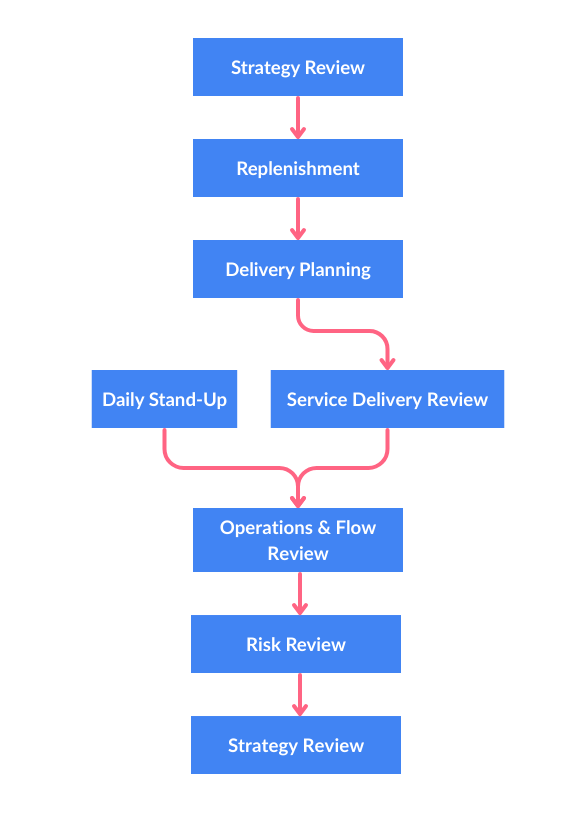
Replenishment draws from the broad-scale intent determined in Strategy Review,
Delivery Planning takes from insights from Flow Review and Service Delivery Review,
Operations & Flow Review amasses signals from all delivery-level cadences to solve system-wide constraints,
and Strategy Review combines operational evidence with market indicators to shape the upcoming Replenishment decisions.
Deciding cadence frequency for your teams
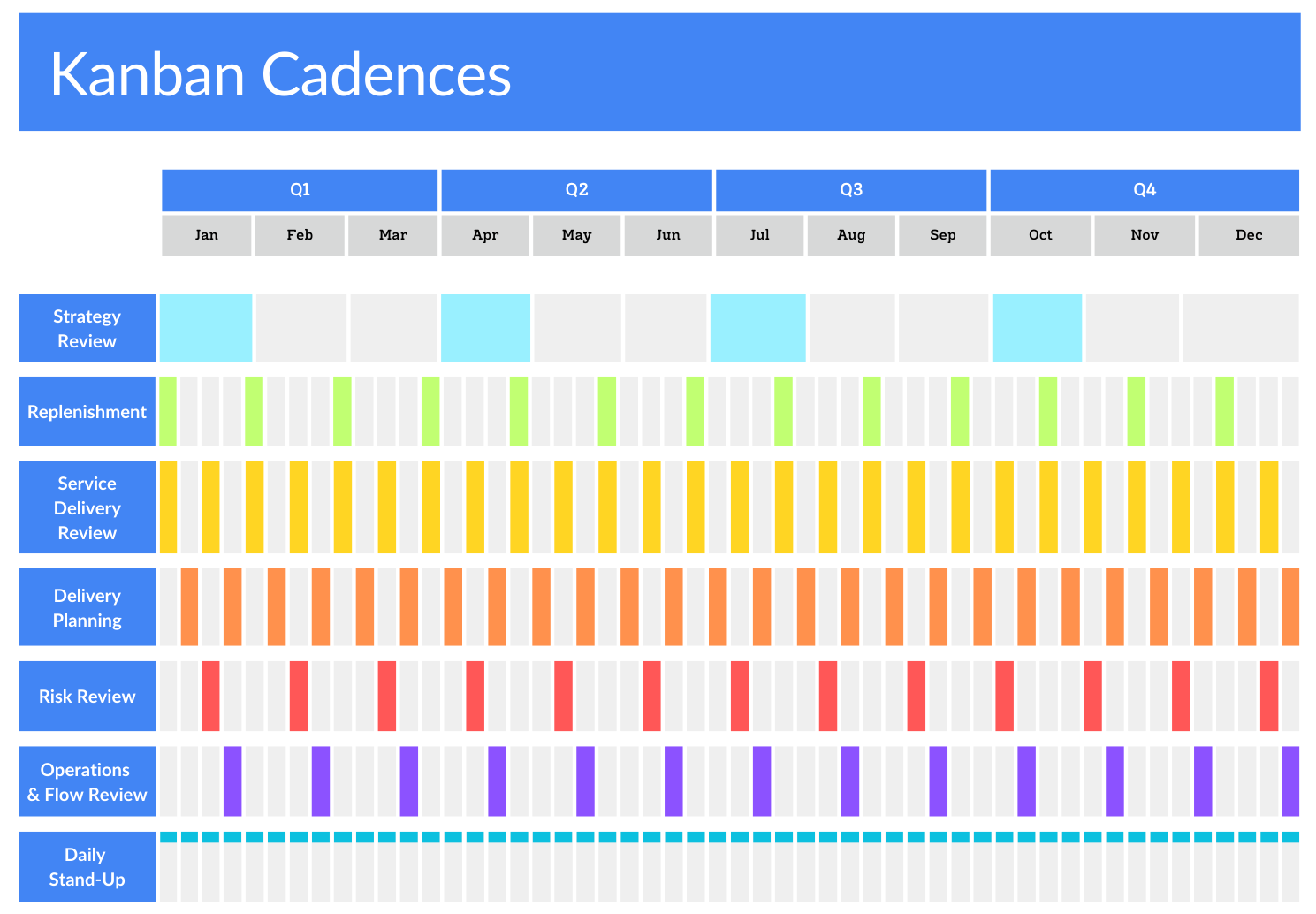
Your cadences’ exact rhythm should match the work domain’s volatility, as well as your organization’s intended and feasible responsiveness level. For instance, Replenishment meetings should be more frequent when demand is hard to predict; Delivery Planning repetition is to be determined by release expectations and downstream consumption cycles. For a review of Service Delivery & Operations/Flow to be meaningful, you need to gather data from at least 2-4 weeks, with Strategy Review requiring even longer cycles, given the scale of decisions that it drives.
The patterns of your cadences must be stable and predictable, but not arbitrary - the meetings will only be valuable when there’s sufficient new information to justify a fresh look.
Marks of efficient Kanban cadences
- The meeting agenda is respected, so that discussions do not drift or prolong.
- The required inputs are prepared in full and on time.
- Decisions are clearly documented, with each planned action having an accountable owner and a data-backed justification.
- Policies live and evolve - if a particular discovery repeats, it has to drive change in policy.
- Participation is based on decision-making rights - only the team members who can act on what’s been discovered should attend (e.g., an SRM, an SDM).
Reducing system noise with Kanban cadences
| Problem | Solution Through Cadences |
|---|---|
| Ever-present churn and urgency | Domain-specific set decision points |
| Conflicting priorities | Traceable task flow at all levels |
| Unclear/missing escalation routes | Defined escalation paths for risks to flow and operations |
| Rework necessary due to vague direction | Coordinated strategy-execution feedback cycle |
| Isolated, unstructured decisions | System-wide service alignment and transparency |
Make cadences the backbone of organizational learning
Applying Kanban cadences and honoring their individual purposes can transform your organization into an integrated learning system, allowing you to build a sustainable rhythm of reflection and decision-making at all levels - from work choosing to strategic direction.
Well-designed cadences reduce ambiguity, amplify system awareness, uncover constraints, and link strategy to execution without a heavy process overhead. In other words, Kanban cadences empower enterprises to act with precision and purpose, also in settings of high variability and uneven demand.

 Český
Český Deutsch
 Español
 Française
 Italiano
 Polski
 Português
 Русский