
Classes of Service & Work Item Types
Many teams fail to effectively prioritize work and it is rarely due to a lack of data.
It commonly results from collapsing two different concepts - the nature of the work and how it should be treated - into a single label. The fusion of work item types (WITs) with classes of service (CoS) creates a system that might be presenting order, but works on unexamined assumptions.
For instance, a team can perceive bugs as urgent, features as optional, research as deferrable, or documentation as expandable. Although none of these presumptions may be economically defensible, they stick because the delivery system cannot explicitly express the cost of delay.
Detaching work item types from classes of service allows for restoring that missing element and using both to design a flow system that perceives urgency and risk with discipline, not instinct.

Work item types
Work item types characterize the substance and intent of the effort - not its urgency.
It should define the kind of activity being performed, guiding how the task needs to be executed and validated.
Examples of common types of work items in software development:
- Feature - introducing or improving product/service capability
- Bug - correcting deviations from the desired behavior
- Risk - mitigating possible future harm
- Research - investigating to define work and reduce uncertainty
- Technical debt - addressing structural deficiencies
Making such distinctions influences workflow design, skill alignment, quality control criteria, and project composition, e.g., a research task won’t follow the same acceptance logic as a bug, and a risk remediation effort won’t share its flow with a feature.
However, work item types don’t mention time sensitivity - a bug can be a cosmetic inconvenience or a critical failure, a feature might be hypothetical, or mandatory due to contract details. Attempting to encode urgency within item types, e.g., “critical bug”, “high-priority feature”, sidesteps economic reasoning, opening the team to escalation-driven behavior instead of decision-determined planning.
Classes of service
Classes of service govern how a task is treated once it enters the system. Rather than labels, they are policies prescribing work sequencing rules, In progress column behavior, capacity limits and trade-offs, as well as delivery expectations.
A class of service informs about:
- How quickly must this task be completed?
- What economic damage follows if it’s delayed?
- What level of disruption is justified to avert that damage?
Work item types are structural, but classes of service are behavioral, and actively form the system’s reactions to pressure.

Cost of delay - the commonly missing variable
The cost of delay (CoD) is the economic rendition of time sensitivity, describing the rate at which value is lost when work is deferred.
Crucially, CoD is not uniform - different tasks deplete value in various ways, losing it gradually or collapsing suddenly at their deadline; producing immediate damage, or uncovering their cost at the crossing of a threshold. Employing classes of service is a way to grant these unique CoD patterns separate flow policies.
There is an essential dependency between classes of service and the cost of delay.
Without the cost of delay, classes of service devolve into subjective urgency assignments. But the cost of delay without classes of service remains purely theoretical - inoperative.
General classes of service
1. Standard CoS - cumulative opportunity cost management
For tasks of a relatively linear cost of delay, where value is lost incrementally with each unit of time postponed, but the compounded loss isn’t adverse.
Examples
- Features with open-ended revenue potential
- Non-critical bug fixes
- Incremental enhancements
- Risk mitigation and discovery work
A software team fixes minor UI glitches and makes small UX enhancements. Though not urgent, delaying work on these tasks slowly crumbles user satisfaction.
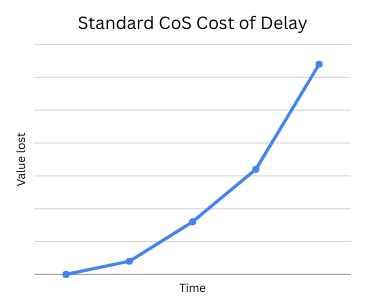
As the cost of delay curve is moderate, standard class of work should flow with as little disruption as possible. To maximize predictability for this class, minimize all variation, stabilize throughput, limit and control Work In Progress.
Delay, though undesired, isn’t the biggest threat to standard tasks - it is systematic displacement: if standard work is frequently interrupted by erroneous urgency, the cost of delay invisibly adds up, making for a stagnant and fragile system.

2. Fixed date CoS - intermittent cost of delay mitigation
For items on which a decrease in value is tolerable until a specific date. A date on which the economic impact shoots up.
Examples
- Regulatory due dates
- Contractual obligations
- Market-bound events
- Coordinated dependencies with external parties
A fintech service must implement a new reporting feature to comply with a regulatory due date on March 31st. Until the date, the feature has no immediate value, but missing the deadline will incur severe fines and legal trouble.
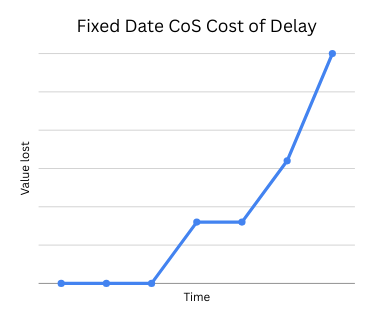
The fixed date class is part of a risk management strategy: the scope of work must be negotiable, since the completion date isn’t. Entry policies for this work class should enforce early commitment, and progress ought to be tracked with data-informed probabilities. Notably, this class should be applied in moderation, as a system that overuses it accumulates hidden risk, loses slack, and fuels emergency behavior due to delays in discovery.
3. Expedite CoS - extreme cost of delay acknowledgement
For work, delaying which would be intolerable, and the cost of waiting dominates the price of interrupting other work.
Examples
- Production environment outages
- Severe customer inconveniences
- Security incidents
- Legal or safety matters
A critical payment processing service has an outage resulting from a backend bug, making customer transactions impossible to complete. It must be fixed immediately to minimize financial and reputational damage.
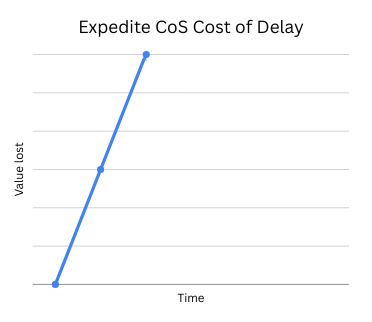
The goal of expedite work is to intentionally break flow discipline; however, every such task imposes a secondary cost of delay on the remaining work - a trade-off that has to be visible and governed with care.
A process often forced to rely on expedites is usually a sign of accumulated neglect, for example, ignoring the cost of delay for standard or intangible items until it becomes severe.

4. Intangible CoS - postponed economic impact confrontation
For work carrying deferred and poorly signaled cost of delay, where the value created is factual, yet its absence doesn’t cause failure, not immediately.
Examples
- Rectifying technical debt
- Systemic platform updates
- Capability increases
- Reducing preventative risks
A development team delays refactoring an outdated authentication module to save immediate effort. There’s no instantly visible impact on users or company revenue. But months later, a new feature cannot be integrated without an emergency authentication module rewrite, resulting in a high-cost expedite situation.
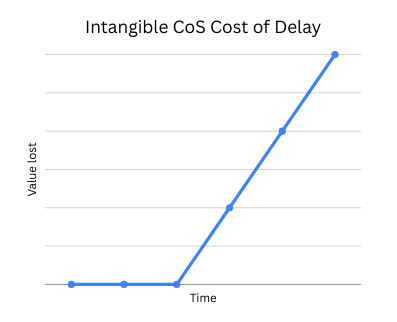
The CoD trajectory for intangible work can be deceptive, being completely flat right until it suddenly isn’t - when the true cost of delay finally surfaces, it will often generate expedites or fixed date crunches at an even higher expense.
Intangible work cannot be guarded by informal prioritization alone, but demands policy-based capacity allocation (to ensure it takes place at all), reliance on WIP limits (to make sure it’s done effectively), and cross-organizational acceptance that minimizing risk is a valuable result.
Did you know?
The Kanban Tool® online platform supports card types and swimlanes, making it easy to represent both classes of service and work item types in your unique workflow. Keep the team’s process transparent and manageable: define the nature of work and its handling policies. Try it out today to streamline your flow!
Combining WITs and CoS without degrading either
The core advantage of this model lies in making work item types and classes of service independent, yet interoperable.
A given work item type can correctly fall under several classes of service, depending on context and impact. For that reason, it’s ill-advised for a team to work on the basis of preset labels when deciding priorities. Instead, it should use explicit reasoning about risk and consequences for every individual item.
In short, work urgency is tied to situational impact, not category alone. Applying this logic also means consistency in how impact and urgency are evaluated across diverse work items.
Predictable flow as a measure of economic value
Predictability of a variable workflow is only achievable by controlling when and how variations occur. Classes of service, grounded in the monetary cost of delay, simplify determining where interruption is justified and where stability needs to be secured.
- Standard work preserves throughput.
- Fixed date work uses up planned slack.
- Expedites insert calculated interruption.
- Intangible work minimizes future volatility.
Common failure modes
| Failure pattern | Origin | Effect |
|---|---|---|
| Too many expedites | Poor upstream prioritization, or restraint in making hard economic choices. |
Disproportionate urgent work disrupts the planned flow. |
| Fixed date applied by default | Due dates are assigned without analyzing cost of delay. | False sense of certainty - tasks are treated as urgent when they may not be. |
| WITs used to signal priority | Giving work a specific label - e.g., bug - just to force urgency. |
Bypassing governance; trust erosion. |
| Lack of entry policies | No defined criteria for assigning classes of service. | Classes of service are applied arbitrarily. |
| Ignoring capacity ramifications | Not accounting for team capacity when introducing urgent work. | Bottlenecks. Expedite and fixed date items absorb team capacity that then needs to be compensated. |
Strategic implications
At a broader scale, aligning work item types and classes of service facilitates portfolio-level and otherwise unattainable reasoning. It informs the organization on how much capacity is absorbed by unplanned urgent work, allowing it to level out investments across innovation, maintenance, and risk mitigation. This ensures that delivery practices support strategic plans. Executives benefit from a strong governance lever without resorting to micromanagement, while teams gain better clarity and are safeguarded from ad-hoc re-prioritization.
Work item types provide structural clarity, classes of service guide economic discipline, and the cost of delay grounds both of them in reality.
Failing to isolate these three concerns can lead companies to be managing urgency narratives rather than work. To deliver predictably and credibly, an organization must design a system competent in making hard trade-offs and absorbing uncertainty without panic. This competence will emerge from treating time as an economic variable and planning the workflow accordingly.
 Český
Český Deutsch
 Español
 Française
 Italiano
 Polski
 Português
 Русский