
Kanban Forecasting with Service Level Expectations
Service Level Expectations (SLEs) are an instrumental addition to mature Kanban systems. They operationalize the flow, drawing on historical cycle times to forecast the probable delivery dates, as well as to sequence work and highlight risks. So, while SLEs are not there to guarantee set outcomes, they expose the system’s factual capabilities, moving away from a reliance on contractual obligations.
They are expectations, not promises, or agreements (SLAs). The very shift from deterministic statements to probability-based estimates grounds your relationship with the customer in evidence, not ambition.
Why does a mature Kanban system need SLEs?
The flow of work in Kanban is continuous, rarely partitioned out into set delivery intervals. This can make teams understandably nervous when facing a customer requesting an estimated end date for their project. A team that relies solely on work-in-progress observation may indeed be tempted to make commitments that contradict all empirical evidence hidden within the board’s cycle time distribution and throughput. Setting up SLEs counteracts this by creating a shared reference point for how long items typically take traversing the system.
A Service Level Expectations value is expressed by a percentile (% probability of completion) within a threshold of the cycle time distribution (# of days) for a specific workflow (between the work initiation and completion columns).
Example
A team may find that 75 percent of all completed items took fewer than seven days to get from Commitment to Delivery.
The SLE of this flow is therefore: 75% of items will be delivered in 7 days or less.
This estimation is a statistical artifact of the workflow’s current performance, serving as a practical forecast boundary that draws from team capabilities and constraints, as well as task variability and dependencies.
Using cycle time distribution to make SLEs
Since the cycle time data is the base here, unclear or fluid definitions of when work begins and ends will undermine the entire model. The Kanban pipeline must accurately capture active work commitment and exit points.

From such a consistently formed dataset, a team can extract the cycle time distributions. Most knowledge-based delivery systems with high task variability reflect heavy-tailed distributions, with the most time consuming items skewing the averages. Switching to probability percentiles eliminates this issue. By selecting a percentile that aligns with the company’s risk tolerance - typically between the 70th and 95th percentiles - the SLE threshold can balance predictability with observation.
Example A Service Level Expectations curve for planning commitments on the basis of data-driven confidence levels might look like this:
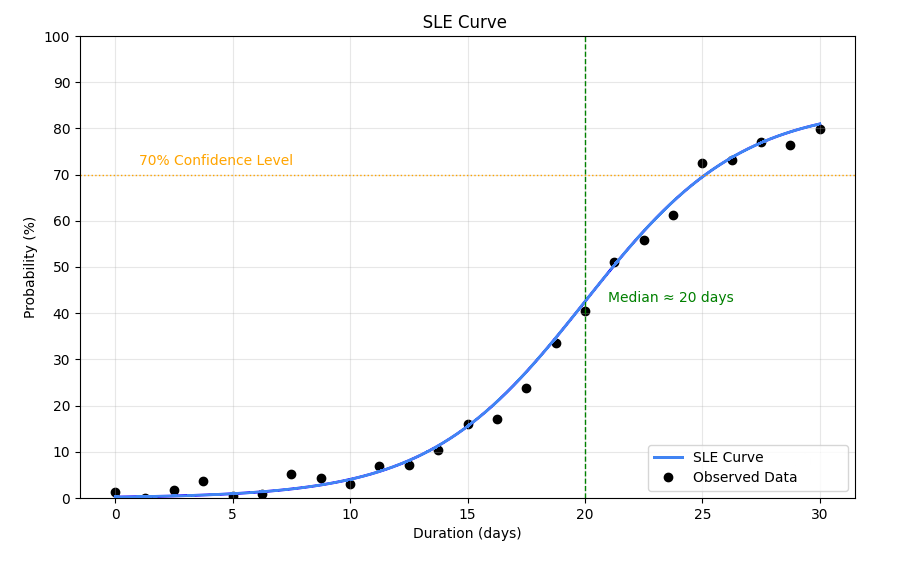
- The blue curve marks the probability of completing a task within a given number of days. It flattens out around 80%, as there’s a natural limit to predictability - completion of a portion of tasks will always be uncertain.
- The green dashed line drawn at the 20-day point marks the median completion time, at which probability reaches around 50%, meaning that half of the tasks can be expected to finish in 20 days.
- The orange dotted line across the 70th percentile shows when most tasks are likely to be completed: in around 23 days. The confidence level derived this way facilitates setting realistic delivery expectations.
- The black dots represent historical completion times. Comparing them to the curve in real-time can help validate predictability and spot signs of anomalies.
- Changes in the Service Level Expectations curve in time can indicate performance trends - the curve moving to the left means increased completion speed, and a shift of the curve to the right signals delays or bottlenecks.
SLEs, not SLAs
SLEs describe the likelihood of outcomes, sidestepping the rigidity of typical Service Level Agreements. SLA asserts a minimum standard of delivery for a team to uphold, or compensate for. SLEs are diagnostic, not prescriptive. If an item exceeds the forecast delivery window, it isn’t a breach of contract, but a signal that the circumstances for that item diverged from a historical completion pattern. While it may warrant investigation, it is not an issue demanding a fix.
This important distinction alters the tone of the team’s planning discussions. Instead of using pressure or arbitrary deadlines to force a commitment, a team analyzes where a proposed work item is likely to sit within the known cycle time distribution. That assessment then informs work sequencing and funding, helps manage stakeholder expectations, but does not set the delivery date in stone. The tone switches from obligation to probability.

SLEs for managing variation
Even the most precise Kanban system cannot eliminate all variability. Task inter-dependencies, batch work arrivals, availability of expert team members, and unplanned work all cause cycle time fluctuations. SLEs explicitly state this variability: the width of the SLE window shows exactly how turbulent the workflow currently is. A narrow SLE window (e.g., 90% of items complete in 3–5 days) marks stable execution and consistent throughput, and a wider one (e.g., 90% of items complete in 3–12 days) suggests that some types or classes of work suffer significant delays and/or unpredictability.
To form better estimates for stakeholders, teams can take one step further and calculate SLEs for various task types. It’s quite common for small tasks (i.e., feature enhancements, minor bugs) to cluster around short cycle times, while large ones (i.e., compliance work, new product design) are more likely to show widely dispersed cycle times. This method of segmenting forecasts provides stakeholders with a clearer insight into the risks associated with different categories of work.
The SLE feedback loop
Since SLEs reflect existing system behavior, they evolve, with each delivery event becoming a new data point for the distribution. As workflow policies, staff, and external demand change, so does the cycle time pattern. Mature teams regularly review their SLEs, adjusting them at points when changes will not disrupt workflow stability. Cyclical re-calibration ensures that SLEs continue to serve as trustworthy representations of current performance.

Such iterative review also aids continuous improvement. High deviations from an existing SLE value can signal systemic issues such as excessive multitasking, neglected upstream refinement, poorly articulated work items, or bottlenecks at particular workflow steps. Of course, the SLE doesn’t resolve these issues, but exposes them quite precisely for the team’s attention.
Presenting SLEs on the Kanban board
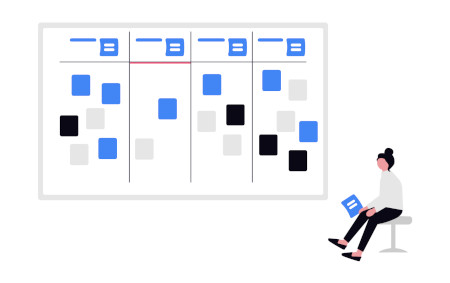
Teams often place SLE markers directly on their digital Kanban boards, enabling stakeholders to inform release planning, coordinate across teams, and even shape funding strategies using probabilistic insights. Such visible alignment of expectations with evidence also reduces unnecessary friction between delivery teams and stakeholders.
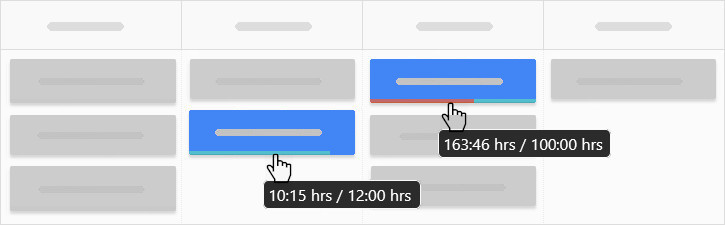
Another common practice is to show the age of each item, either as a bare time value or as a relation between that time and the SLE boundary. Doing this adds a time-oriented risk dimension to the board.
Tasks crossing the forecast boundary immediately draw attention, but the purpose is not so much escalation as anomaly detection, alerting the team to revisit prioritization guidelines and flow policies. This added visibility strengthens operational discipline and warns of fluctuations in the ongoing delivery cycle.
Did you know?
Kanban Tool® provides built-in process metrics, such as lead and cycle time, estimated and elapsed time tracking, cumulative flow diagrams, as well as an API for extracting your own data - all ready to fuel your SLE values.
Make analyzing and improving your workflow faster and more precise than ever!
Integrating SLEs with other metrics
As SLEs operate alongside throughput, work-in-progress limits, arrival rates, and task aging metrics, it’s best to build an ecosystem in which these elements can reinforce one another. For instance, if an SLE proves significant unpredictability, throughput data can help identify whether arrival rates regularly exceed capacity. Tracking adherence to WIP limits can reveal if tasks are being started concurrently, eroding predictability.
Similarly, you can utilize Little’s law to cross-check the validity of the presented SLE: if the average WIP task count and throughput value do not align with the average cycle time, then the used SLE may be resulting from local anomalies or inconsistent definitions of completion states. Performing a regular cross-metric check should reinforce system integrity and prevent misinterpretations.
Embedding SLEs in policy

As SLEs gain a stronger footing in the system, they often become integrated with the company’s operational policies. For instance, a policy might state that items approaching the SLE boundary get priority attention, or that work types historically exceeding forecast delivery rates demand extra refinement. These types of policies build mechanisms for guiding the workflow without imposing quotas or strict deadlines.
Managers can also use SLE data to spot performance trends, using SLEs in place of traditional performance assessments to examine distribution shifts, changes in completion predictability, or the results of improvement experiments on an SLE curve.
SLE adoption calls for culture adjustment
Adopting SLEs assumes a cultural shift toward transparency and a higher tolerance for uncertainty. Teams adapted to deterministic project plans are prone to resisting probability-based forecasts, because their old way of planning was giving them an illusion of total control. However, at the heart of Kanban lies an emphasis on enabling flow through observation and adaptation, not removing uncertainty through artificial commitments.
After a team has internalized the new mindset, SLEs form a natural instrument for operational transparency, facilitating open dialogue about risk, variability, and constraints. That, in turn, allows for making more informed trade-offs and removes the tension typical in deadline-driven models.

Service Level Expectations provide Kanban teams with a data-based mechanism for analyzing and forecasting flow performance by capturing the statistical reality of cycle time distributions. Built entirely on real data, SLEs enhance the team’s credibility and provide an accurate understanding of the delivery rates the team can reliably achieve.
Further reading
- The Kanban Pocket Guide (BOOK)
- Actionable Agile Metrics for Predictability (BOOK)
- When Will It Be Done?: Lean-Agile Forecasting to Answer Your Customers’ Most Important Question (BOOK)
- Practical Kanban: From Team Focus to Creating Value (BOOK)
- Actionable Agile Metrics for Predictability Volume II: Advanced Topics (BOOK)
 Český
Český Deutsch
 Español
 Française
 Italiano
 Polski
 Português
 Русский