
Kanban Roles and Responsibilities

The fact that the Kanban method doesn’t specify new roles for a team adopting it is one of the key factors that made the framework as popular as it is. That’s simply one less thing to tackle when changing how your team works. Paired with the notion of the team continuing to do what they’re doing, and simply adding a visualization, Kanban’s non-prescriptive nature makes smooth transformations possible.
Responsibilities such as pulling new cards into “Doing” along with all other board updates and cross-specialty collaboration planning must be left solely to the delivery team members: developers, designers, testers, operations engineers, analysts, and support agents. Additionally, for them to embrace Kanban with its continuous improvement angle, the delivery team must remain encouraged to suggest process upgrades, pointing out what doesn’t work and why.
However, depending on your company size, the type of work you do, and the operational strategy applied, new roles may be required for the system to function optimally.
Service Request Manager (SRM)
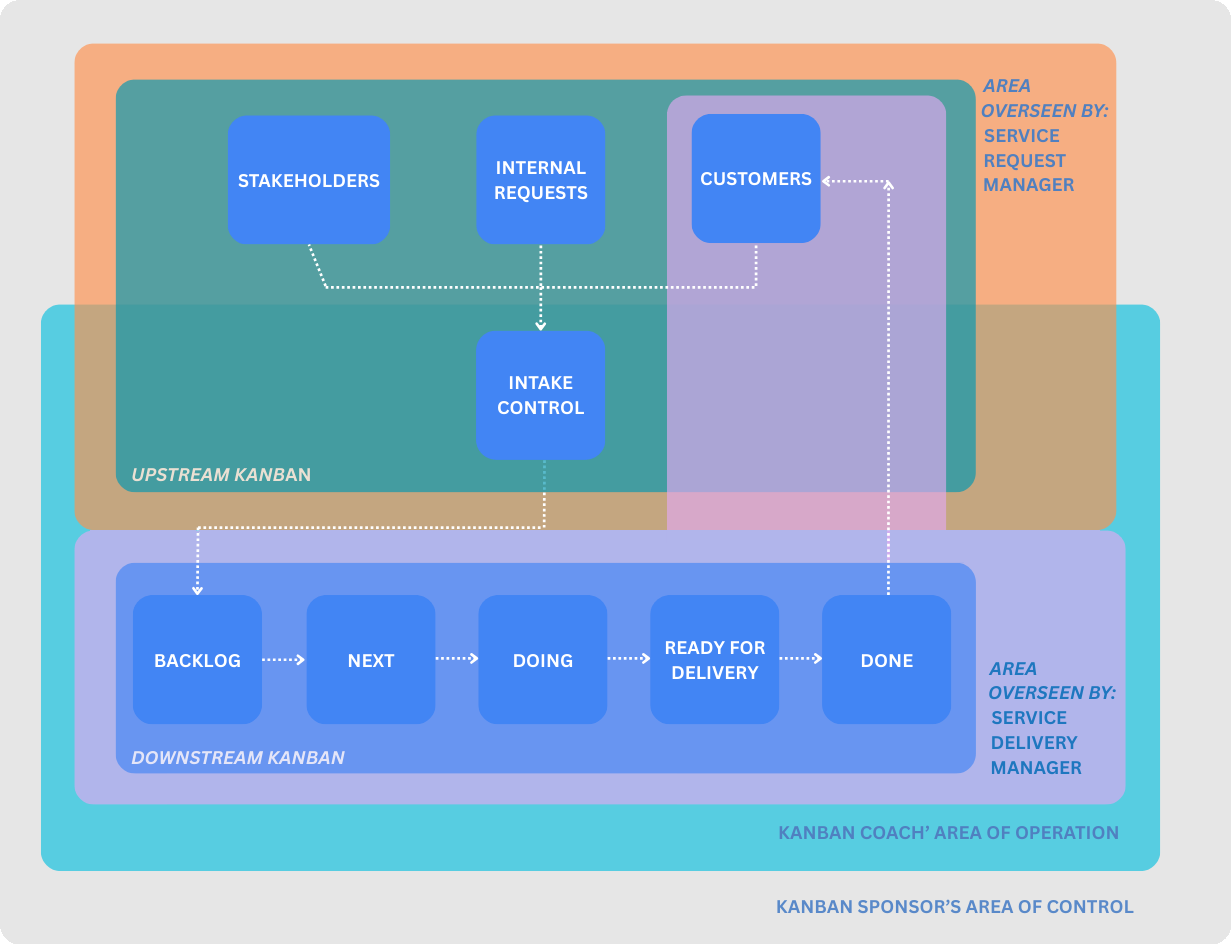
The goal of the SRM is to control the upstream Kanban. New service requests (tasks, orders, etc.) must be categorized, prioritized, and estimated, with the requirements and accepted outputs confirmed with the request issuer (customer, stakeholder, team) if needed.
The SRM is therefore the primary communicator between a team and their backlog inputs; having real-time insight into team capacity and service demands positions the manager perfectly to balance the two.

Crucially, the SRM is there to understand customer needs and assist in translating them into value-delivering requests, clearly formulated for the downstream team. The manager’s role also includes guiding and maintaining appropriate definitions of classes of service and handling any dependencies between them. On that basis, the team can self-manage the order of task processing.
To whom should you assign the SRM role?
The Service Request Manager must be familiar with the product or service to aid in its development, and present high interpersonal skills for bridging any communication gaps between the customer/manager and the delivery team.
If you need to pick an SRM from among your existing team, consider account managers and sales representatives. If the team already has a Product Owner, make them the SRM.
Service Delivery Manager (SDM)
Where the SRM manages the team Kanban board inputs, the SDM oversees what the team does with it - the quality and speed of delivery. As such, the Service Delivery Manager tracks performance by relying on data derived from the team board: lead and cycle times, throughput, WIP, stale tasks, bottleneck reasons and length, etc.
Moreover, the SDM conducts delivery reviews and backlog replenishment meetings to gather insight into persistent systemic issues or teamwork inconsistencies. In other words, the SDM is a key player in driving continuous improvement in the process and its responsiveness to customer expectations. To that end, the SDM also verifies delivery alignment with any Service Level Expectations or Agreements in place.

To whom should you assign the SDM role?
The Service Delivery Manager must have intimate knowledge of the team’s process, the dependencies constraining it, and any potential conflicts. Statistical literacy and problem-solving skills are a must.
If you need to pick out an SDM from among your existing team, consider your business analyst or team manager. The responsibilities involved are similar to those of a Flow Manager, so if this position already exists, consider transforming it into an SDM.
Did you know?
To simplify gathering your process performance metrics, you can use a Kanban Tool® board with Cumulative Flow, Lead & Cycle Time data and Time Report built-in.
Minimize process evaluation time and use the saved hours for work itself!
Kanban Coach
A Kanban Coach or, more broadly, an Agile or an improvement/efficiency expert, is often introduced to aid the adoption of Kanban, particularly in organizations rigidly set in their ways of working, or in large teams. The Coach will oversee the team’s learning about the framework, train them through workshops or mentoring, while also guiding system design and fueling the team’s openness to change, to revise how they operate.
Though the Coach will typically be an external consultant, it’s not uncommon for large organizations to employ these experts full-time.

Kanban Sponsor
As interest in Kanban became more widespread, this role became less common; nevertheless, it remains crucial in organizations with highly complex structures. Unlike the other optional roles focused on flow management, intake pace, and daily Kanban practices, the Kanban Sponsor works towards a swift implementation from the highest level. The Sponsor will coordinate support (which often includes arranging funding), necessary to enact consecutive phases of change, e.g., covering training time and costs, reviewing team member positioning in company locations, etc.
Moreover, the Sponsor is there to tackle high-level opposition and adoption impediments, resolve any managerial conflicts, and foster the required cultural changes, taking on the role of a Kanban evangelist of sorts.

Provided that your delivery team follows their Kanban process with sufficient respect and effectiveness, and that there is someone who ensures the flow is ongoing, as well as someone who controls the incoming demand (both could be part of the delivery team), you probably don’t need any other direct facilitators. The demand for supplemental roles depends on your unique context.
Extensive workflows, with multiple frailties stemming from suppliers and customers, do rely on an SRM and SDM to better align their value delivery with customer expectations and to do so on time.
 Český
Český Deutsch
 Español
 Française
 Italiano
 Polski
 Português
 Русский