
Blog
Stuck No More: Understanding and Eliminating Work Stagnation19 Jan 2026
Work items lingering in the middle of a process, half-built, half-reviewed, or half-thought-out, are a structural and cultural signal that something isn’t flowing the way it should. Although many would interpret stalled tasks as personal failures or laziness, they’re rarely that. Usually, the real culprits are systemic.
Where does stagnation come from, what patterns does it follow, and how can you break it? The root issues can be broad, and so should be the solutions.

The anatomy of stagnation
Before you can dislodge stuck tasks, you need to understand why they froze up. The majority of workflow stagnation results from a couple of recurring causes:
Task ownership ambiguity
Work typically begins with a healthy dose of clarity: someone kicks off a ticket, starts building a feature, or drafts a plan. However, when the task hits a dependency - e.g., someone's input, approval, or a decision is needed - its ownership gets diluted. Oftentimes, everybody assumes that someone else will pick it up, yet no one does.
This type of scenario is prevalent in cross-functional teamwork: several individuals have partial responsibilities for the task, but no one is explicitly accountable for driving the item to a close, and so, inertia sets in.
Excessive work-in-progress
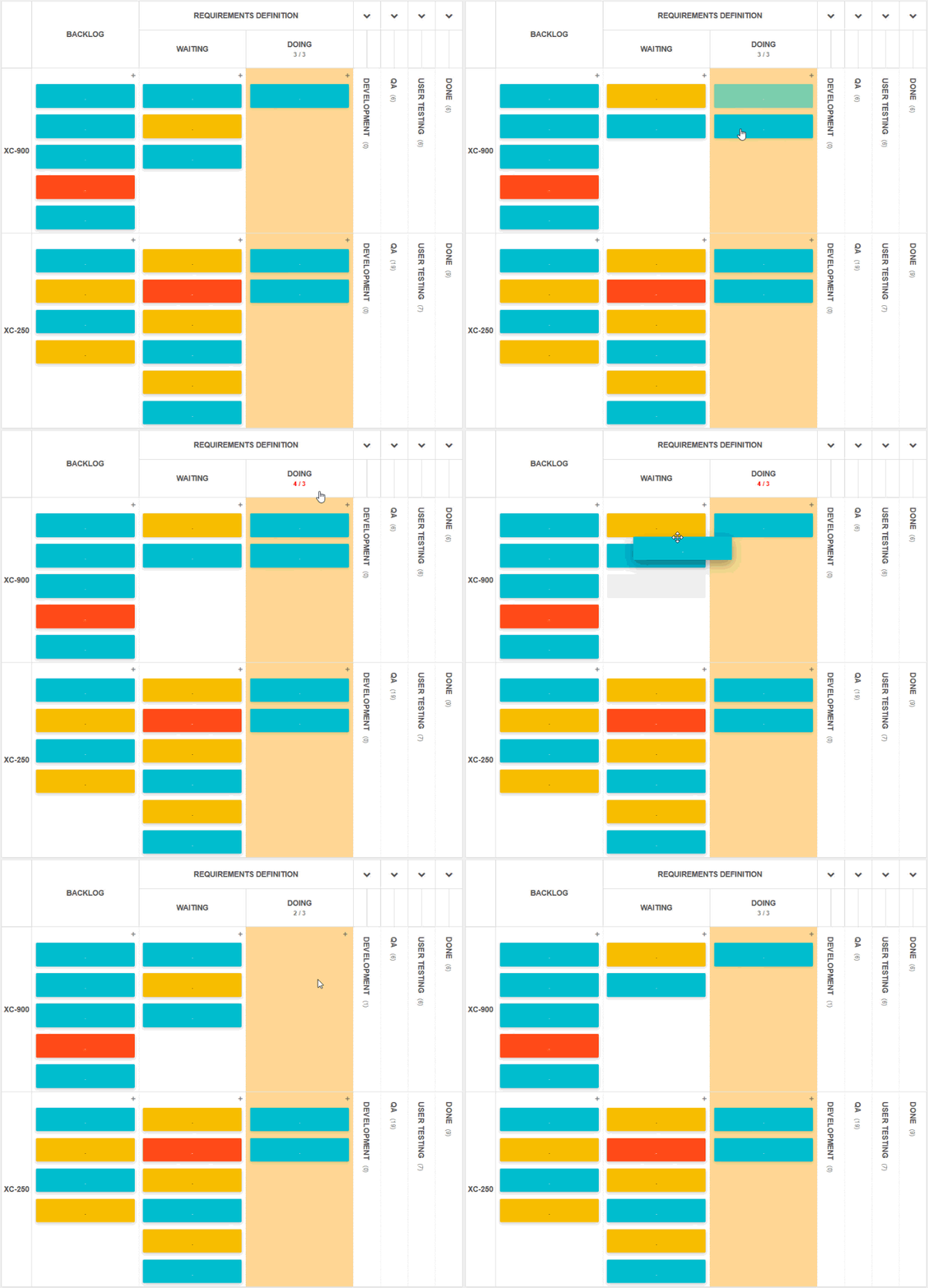
Too much concurrent work inevitably leads to some of the items being neglected. Even worse, people try to multitask to meet competing priorities, yet all that accomplishes is increasing context switching and reducing total throughput. At this point, your “in progress” lane can become a carousel rotating partially completed items, all stuck at various stages.

Hidden blockers
Many progress blockers are overt - waiting for information, for an unavailable reviewer, or a legal sign-off. But others are more insidious: the requirements are unclear, there is technical uncertainty, or - possibly most commonly - there's an emotional resistance to confronting complex or somehow sensitive work. It's those invisible blockers that often fly under the radar, because teams haven’t built habits of surfacing or visualizing them.
No pull/pick-up discipline
In Kanban (and Lean thinking more generally), new work should only be started when there’s capacity to process it. However, in many organizations, work is pushed - via deadlines, roadmaps, stakeholder requests, or OKRs, regardless of whether the team has sufficient capacity to take it on. The push-first mentality clogs systems with too much “in progress” work - work, on which nobody is focused.
Surface-focused team culture
Many organizations show a tendency to favor visible busyness over outcome-based progress: teams celebrate and highlight how much work has been started, instead of how much is complete. This creates a kind of psychological sunk-cost trap, where people keep initiating new work over finishing the things they've already begun.
Spotting stuck items early
To minimize delays and complications, it's best not to let stagnant tasks develop into a full-on process bottleneck. Your team can proactively track:
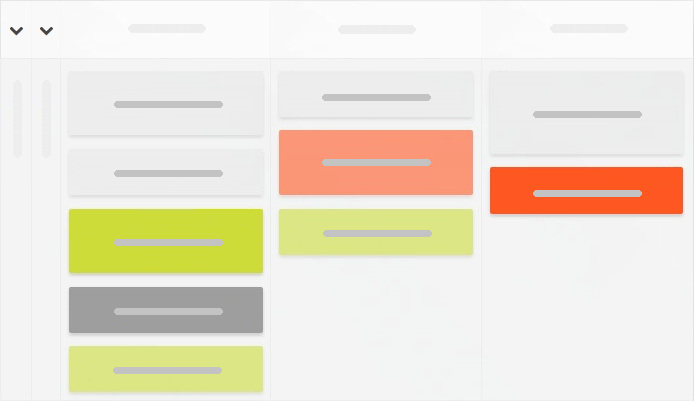
- Aging work items: How long has this card been in its current column? Can we still say that it is moving?
- Cumulative flow diagrams: Is your “in progress” band expanding disproportionately?
- Lead time variance: Are certain types of work items routinely taking far longer than others?
The goal here is not to assign blame or find fault for the sake of it - what you want is to surface anomalies: work items defying the usual rhythm of progress.
Unblocking work with structural changes
Introduce WIP limits that matter
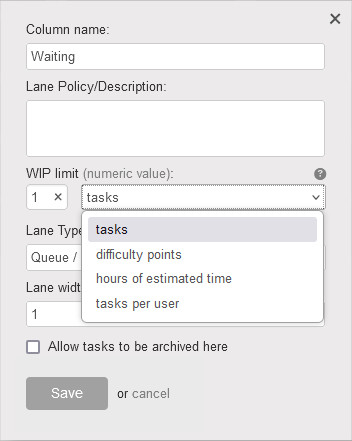
Setting WIP limits isn’t about arbitrary control of your team, but about facilitating focus. If your WIP limits feel like a suggestion instead of a constraint, they’re probably not doing their job.
Start with realistic but rather low limits. When something gets stuck, the team will have to face an all-important tradeoff: unblock it, or don’t pull new work. It's this tension that forces meaningful prioritization, while also allowing your team to focus solely on the job at hand. Just the one!
Define explicit pull conditions
Create a definition of what it means for an item to be ready to be pulled into the next stage. That would be looking beyond the fact that someone may have already started working on it. It would mean the task met a set of criteria, such as a clear definition of done, all blockers identified, and all necessary assets available.
By taking the time to formalize readiness criteria, your team can reduce the chance of half-baked work moving forward, only to stall at a later stage.
Set aside blocked items
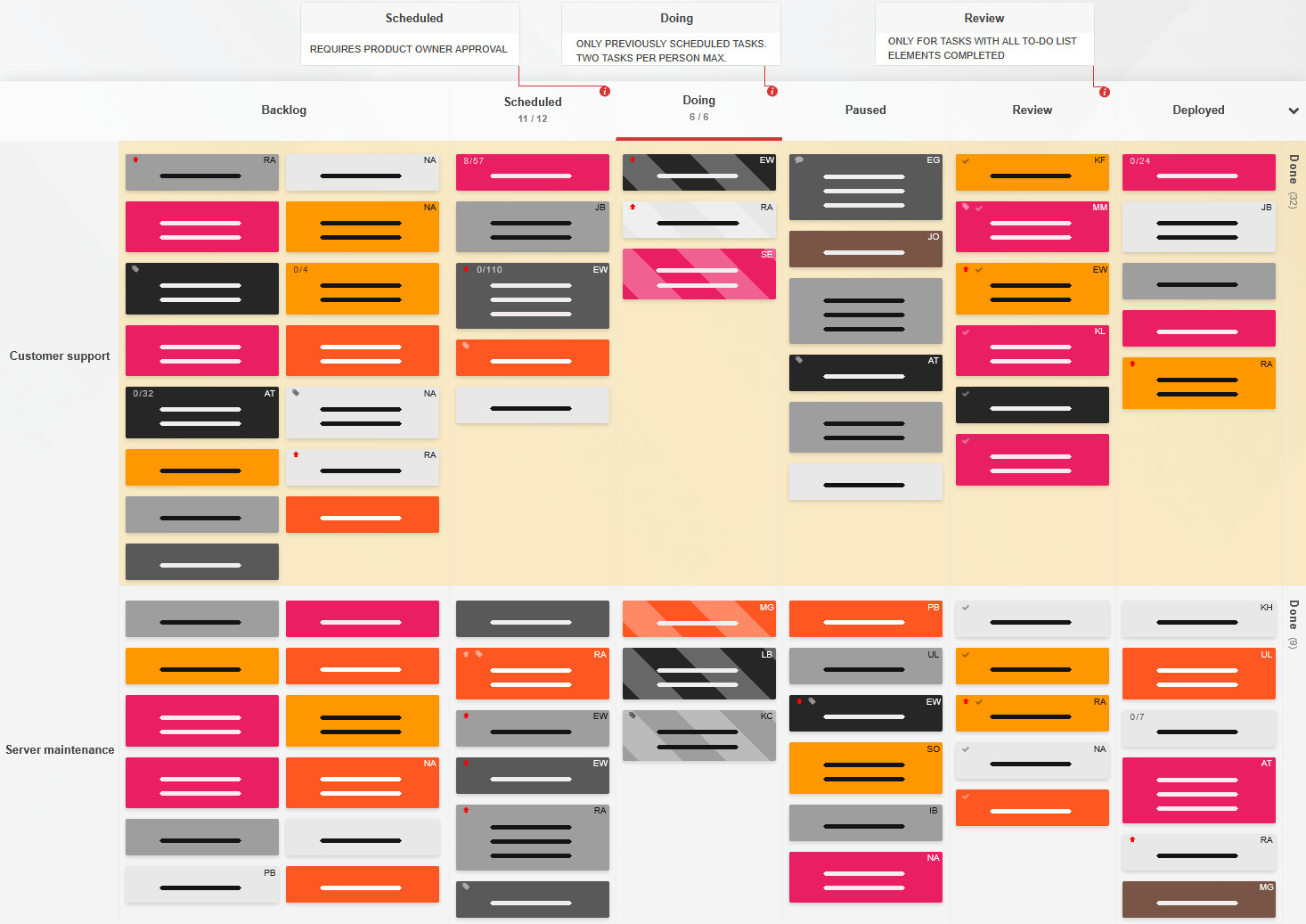
A dedicated blocked column on a Kanban board is more of a cultural signal than a visual aid alone. It tells the team and stakeholders that attention is needed. Making the friction points visible is the opposite of hiding uncomfortable workflow issues away.
Many teams go further, holding daily 5-minute "unstick" huddles to answer what is blocked, what they should escalate, and who can unblock it?
Create explicit abandonment or reprioritization policies
While eliminating blockers is key to a steady workflow, not all work should be finished. Some items freeze because they’ve outlived their strategic value, but nobody takes the time to remove them. It's therefore worthwhile to make policies that support intentional abandonment when justified.
An example policy might be that if an item hasn’t been moved in X days, the default action would be to remove it from the board until it’s revalidated. It would help to minimize the cognitive clutter of a board filled with ghost tasks.
Cultural levers for unlocking flow
Beyond process issues and their potential solutions, long-standing task stagnation can often point to cultural gaps. A few things to look out for are:
Psychological safety around the unknown
If your team members hesitate to surface blockers in fear of appearing incompetent, the entire system suffers. Enforce a no such thing as a stupid question policy, and normalize phrases like “I’m not sure how to proceed”, “This is more difficult than I expected”. The key to preventing quiet, passive delays from taking root is shifting the energy from blame or embarrassment to problem-solving and an open dialogue.

Reward finished work
It is the leaders who can recalibrate incentives - instead of celebrating throughput volume, start highlighting high-fidelity completions: clean hand-offs, documented learning, actual delivery. While this does sound simple, it takes discipline to shift your recognition patterns, and for the new incentive to register with the team.
Actively revisit priorities
There are times when work is stuck not because people don't know how to handle it, but simply because it has lost importance; it's just that the backlog hasn’t caught up yet. It's good practice to hold weekly or biweekly reviews focused not on what’s next, but on what’s stopped moving. Ask whether the task still needs doing at all. When done right, this simple action creates space for unspoken shifts in strategy to surface.
The potential Kanban advantage
The real power of Kanban lies in the effortless feedback it can offer, making invisible friction visible. However, visibility is only the start, the challenge is what your team does once that friction is exposed.
If you're practicing Kanban and are still seeing long-lived work items, it may be time to revisit your policies. Are blocked items acted upon? Are WIP limits enforced? Is aging work treated as a signal?
When paired with honest, high-resolution conversations about progress, Kanban can become a diagnostic utility, not only a colorful work tracker. The more rigorously your team engages with it, the more it pays you back.
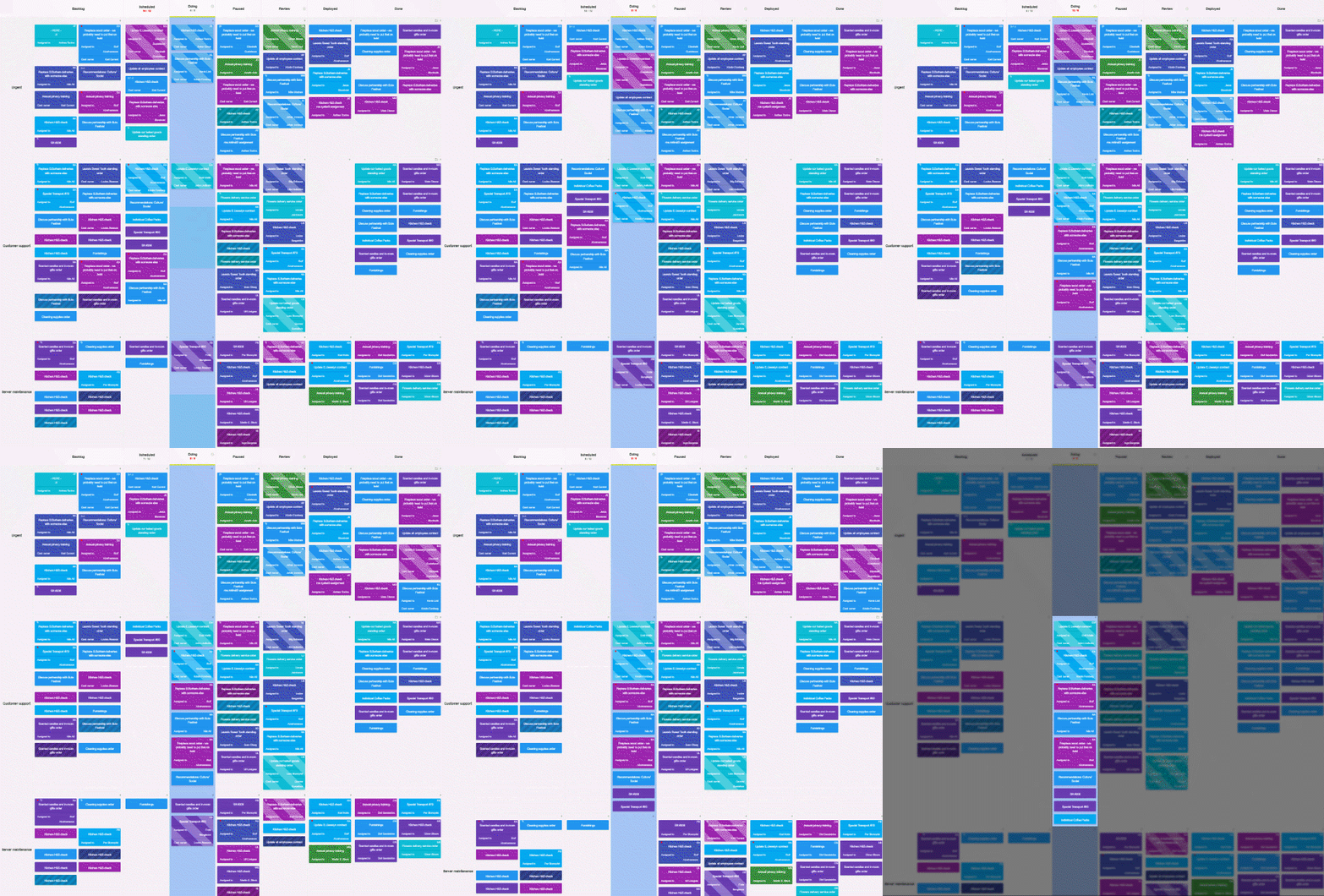
Stagnant tasks are rarely just a function of a high workload. They usually reflect how you have been making decisions, how you are surfacing risks, and how your team members hold each other accountable. Instead of chasing faster delivery, it may be worth looking at how the work that’s already started can move along with less friction. Clearing that middle mile, where a standstill occurs, is often the most meaningful move a team can make.
Sign up for a 14-day free trial
to test all the features.
Sign up now and see how we can help
your organization deliver exceptional results.
 Český
Český Deutsch
 Español
 Française
 Italiano
 Polski
 Português
 Русский