
Blog
Building Psychological Safety Through Kanban16 Jul 2026

The immediately visible artifact of Kanban adoption by a team is the process board: colorful cards moving through stage-representing columns - clear and straightforward. However, what gives Kanban its real power is not so much the visualization itself but the climate it is able to foster - a climate where team members feel free to reveal problems, difficulties, and doubts without fear of being assigned blame or incompetence. That sense of psychological safety is what differentiates a process board that’s just a status display and one that forms a genuine problem-solving tool.
Create transparency without assigning blame
Real-time work status visibility that Kanban affords can either empower or intimidate, depending on how the team and leadership handle it. With every card on the board being treated as an opportunity to measure individual performance, people are likely to start hiding delays or quietly bypass the system. Their board then becomes a distorted theater rather than an accurate mirror of the work state.
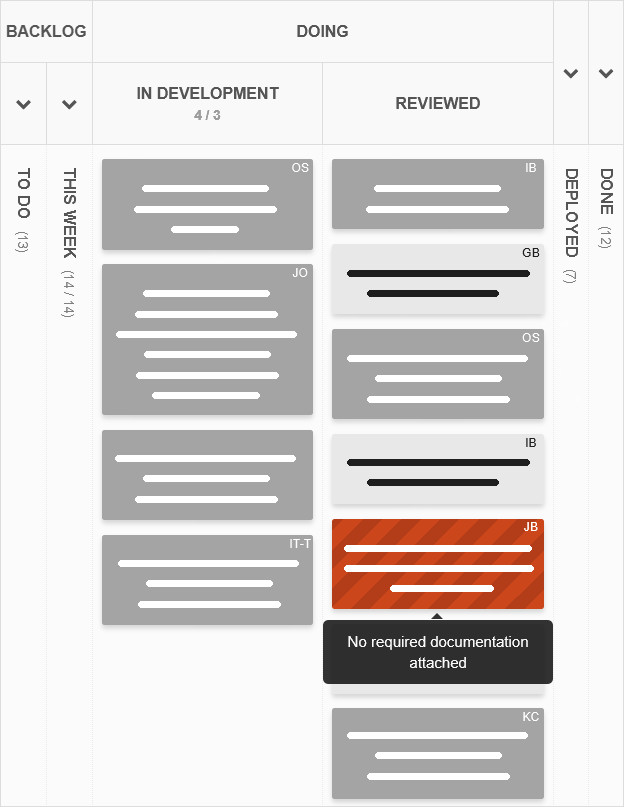
To counter this behavior, transparency needs to be framed as collective, not individual. A blocked task should not signal who failed in their duties, but where the system is flawed or struggling. A blocker placed on a card communicates a bottleneck in flow. The psychological shift here is subtle but critical: blockers are neither confessions nor finger-pointings at a weak team member; they are signals of workflow obstacles. By reinforcing this framing in a consistent, deliberate way, leaders can reduce the instinct to hide problems and instead invite the team to inspect and solve them together creatively.
Use metrics for the team, not against it
Kanban-specific performance metrics: cycle times, throughput, WIP levels, are powerful summaries of how work proceeds. However, it's important for them not to be weaponized against the team. If a manager uses cycle time averages to call out individuals, the team quickly learn to perceive that data as a liability. Charts then stop representing reality, and the system can start being gamed to make the charts look right.

Non-punitive metrics are essential, yet it doesn’t mean ignoring performance. It means asking questions about the system and flow rather than about people. A graph of average cycle times isn’t a leaderboard; it’s an insight into how predictable delivery is, where variation spikes, and what causes work to stall. A metric treated as a starting point for joint inquiry turns into a neutral artifact - information utilized to focus discussion on improving flow rather than assigning fault.
Such a consciously created trust effect has the potential to be cumulative: the more often people see metrics used for collective improvement, the more willing they are to surface anomalies, knowing they won’t be punished for them. Over time, this can shift the team’s relationship to data: from something to dread and defend against, to something they use to diagnose and improve their shared environment.
Design the board with everyone in mind

It's not difficult to design a Kanban board in a non-neutral manner, it can easily happen unintentionally. For example, a board that only prioritizes development tasks can diminish the contributions made by team members who do testing, deployment, or support work, which is just not as critical. When only part of the team sees their work reflected as important, the board can work to reinforce silos and friction, instead of reducing them.
Inclusive, collective board design invites every discipline to map its contributions and constraints. A tester seeing their work tracked alongside development feels recognized as an equal part of the system, an operations engineer’s work being acknowledged gives their efforts the same visibility as feature work. The board itself becomes a symbol that everyone’s effort matters.
Besides the positive influence on the team morale, this also has a practical effect: bottlenecks are easier to spot when the entire workflow is visible.
Reinforce the feedback loop of safety
Psychological safety around a team's workflow is not static, it can be reinforced or undermined whenever someone raises an issue. With Kanban, stress tests are the moments when a card is blocked, or when a queue builds up. If the team responds with curiosity, asking What’s making this harder than usual?, the loop strengthens, but if the response is criticism, the loop weakens, and future problems will surface with less certainty, if at all.
A team experiencing their system as working for them - issues getting resolved faster, bottlenecks being addressed, workloads turning more predictable - builds trust in both the board, and in itself. That trust resurfaces as more honest reporting, which in turn generates better information-based grounds for problem-solving.

Take a step beyond the Kanban mechanics
Kanban is often introduced as a method to improve the flow of work. But in practice, its impact on team and process culture is just as significant. By emphasizing transparency that doesn’t expose, metrics that illuminate rather than punish, and boards that include the entirety of the workflow, Kanban can serve as a solid scaffolding for the team's psychological safety.
When people are allowed to stop spending energy on self-protection, they become free to spend it on solving real problems - and it is that, rather than any efficiency gains, that is the real leverage of Kanban.
Sign up for a 14-day free trial
to test all the features.
Sign up now and see how we can help
your organization deliver exceptional results.
 Český
Český Deutsch
 Español
 Française
 Italiano
 Polski
 Português
 Русский