
Blog
Beyond Visualization: How Kanban Enables Self-Regulating Teams17 Sep 2026
Kanban is usually thought of as a visual scheduling tool, but its less vividly discussed potential lies in the way it can reshape how teams regulate themselves. When a Kanban-based process is set up with intention, its utility reaches beyond a visual board with cards and columns: it forms a living framework through which teams define their pace, and adjust their behavior as and when needed - without the need for constant managerial oversight. In this article, we will explore the mechanics of how Kanban fosters team self-regulation and autonomy, how this ability is embedded in its design, as well as what may happen when those principles are ignored.

From visibility to autonomy
Kanban provides radical workflow transparency: every item of work exists as a visible artifact in a spot of the board that represents its completion state. The presentation of work status out in the open differentiates Kanban from traditional to-do lists or spreadsheets. The achieved visibility creates a shared language across the team:
- Progress is explicit.
Each card’s position on the board proves where it stands, removing the need for status update requests. - Problems surface naturally.
A task that lingers in a specific stage for too long can be immediately identified as a bottleneck, without a manager having to point it out. - Capacity is clear.
A column approaching or exceeding its Work In Progress limit signals that the team has reached its sustainable threshold.
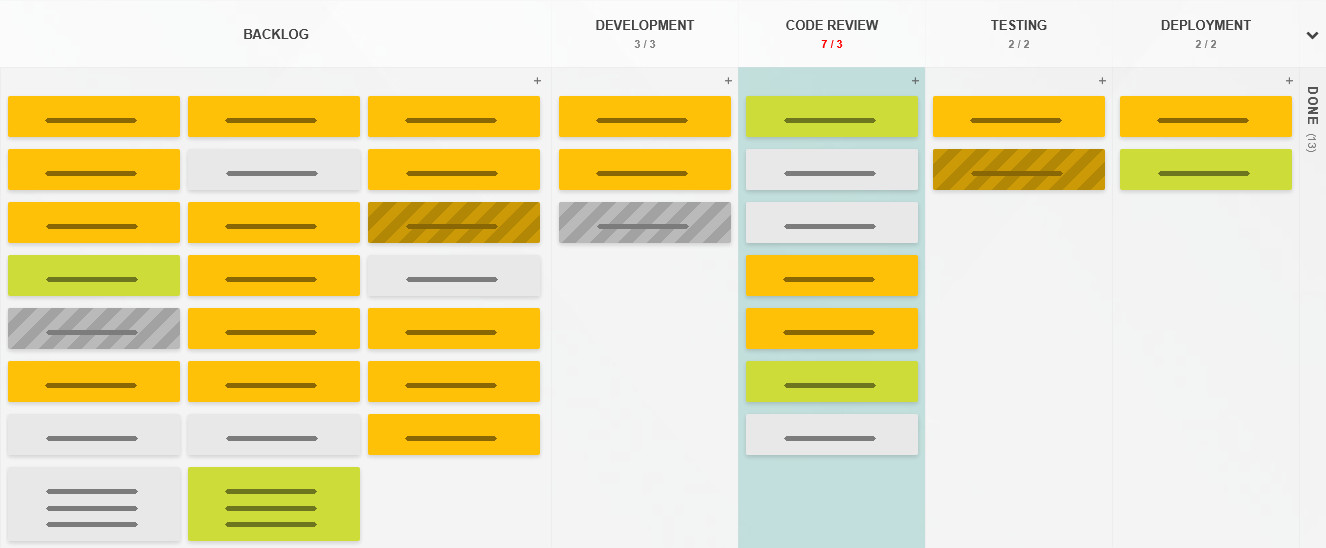
The real-time progress visibility reduces the amount of hidden work that often requires managerial intervention to uncover. Instead, the team can regulate itself because the system readily reflects reality.
WIP limits as behavioral constraints
Work-in-progress limits are a powerful feature of Kanban, yet are somewhat underestimated. On the surface, it presents a simple restriction: no more than a set number of items can sit in a given process step, but in practice, it can change team behavior profoundly.
Column limits prevent the team from overcommitting by making it impossible to start new work when the column is full. This reorients attention away from individual busyness and toward smoothing out the flow through the entire system. WIP limits can also spark dialogue; when they push back against new tasks, the team is compelled to ask: why are we stuck, how can we come together to clear the blocker and move forward?
Applying and respecting these limits does the quiet work of discipline, removing the need for a manager to monitor the amount of ongoing tasks, as the board is showing that clearly. With time, sticking to the constraints becomes a habit; team members naturally pause before initiating new work, instead looking at how they can help finish what's already underway.
Driving adjustment with feedback loops

Self-regulation is not possible without feedback, for which Kanban embeds multiple mechanisms. The board in itself serves as a daily feedback loop, with stand-up check-ins centered not on individual reporting but on the flow of tasks. Flow metrics further expand this feedback - a cumulative flow diagram exposes systemic imbalances, service-level expectations can based on actual cycle-time measurements, while throughput trends reveal if the team pace is stable or deteriorating.
This kind of feedback shifts attention from individuals to the system. Rather than debating who is or isn't working hard enough, the team learns to focus on areas where work is slowing down, on verifying if their commitments are realistic, and how the system could be improved. It allows the team to regulate itself in response to evidence, not arbitral orders.
Pull-based commitment and self-organization
Traditional task management kept control outside of the team: someone decided who did what and when. Kanban replaced this with an autonomous pull-based system. The backlog items are prioritized, but it's the team that decides when and what to pull. And because commitments are voluntary and priorities are clear, the team can align its pace with capacity.
The effect is acute; when team members pull work personally, they take ownership of it; when they observe the order of the backlog, they can challenge or clarify priorities; and by controlling the pace of commitment, they resist the cycle of overburdening followed by burnout. Their autonomy is a daily practice rooted in the board's mechanics.
Managers turn system designers
Kanban redefines the role of leadership, turning managers from task supervisors to systems designers. They shape the board layout, set the limits, establish the process stage policies, and decide which metrics to track. But once the framework is in place, the team operates within it with significant independence.
It makes for a considerable inversion of traditional managerial control:
- The manager becomes a gardener of constraints, cultivating the conditions to foster autonomy.
- The team becomes the active agent within those constraints, learning to adjust behavior on the basis of the system’s feedback.
- Authority shifts from a central individual to a team-owned system.
This rebalancing lets teams function with far less external interference, given that the system already encodes all the necessary discipline.
Examples
Successful autonomy in software development
Let's consider a mid-size software development team responsible for maintaining and expanding a web application. Before turning to Kanban, they operated under constant external prioritization: the product manager assigned tasks, developers picked them up, and managers tracked progress through regular meetings. The results were: long lead times, frequent interruptions to check on progress, and an overload for most team members.

When introducing Kanban, they first started with their existing workflow of Backlog, Development, Code Review, Testing, Deployment; yet imposed modest WIP limits: three items in Development and two in Code Review. Within a couple of weeks, the board revealed that Code Review was their process bottleneck. And, rather than wait for the manager to notice, the developers took action by rotating review responsibilities.
Moreover, the pull system naturally regulated their behavior: developers stopped starting new items when the board was full and instead shifted effort toward testing or reviews. Reliable cycle time data gave them the confidence to commit to delivering small bug fixes within three days. And the daily meeting changed character from a reporting ritual to a team-led conversation about clearing flow blockers.
Over a number of months, the manager’s role has also evolved. Instead of tracking who was doing what, her attention shifted to refining the system itself - experimenting with column policies and WIP limits, adding a clearly defined path for urgent tasks. The team had taken control of regulating its own work, while leadership tasks changed to maintaining the environment's health.
When autonomy breaks down

Of course, not every Kanban implementation will lead to autonomy. Another team in the same organization adopted a similar board, yet their specific approach undermined the very principles of Kanban. Though columns were clearly defined, the WIP limits were treated as suggestions rather than constraints. Developers frequently began new tasks even though the columns were already overloaded, reasoning that, as long as they were “keeping busy”, it made no difference which task they focused on. As a result, the board got filled with half-done work, becoming a picture of excess rather than flow.
To make matters worse, the product manager also bypassed the pull system, inserting urgent items directly into Development, often assigning them to specific people. It quickly taught the team that the rules of the board can be ignored at will. Meanwhile, backlog prioritization was opaque; tasks appeared on the board without explanation, with priority assignments happening behind closed doors. The board wasn't representing shared understanding; it was only a formality.
Since process metrics were neglected, the team had no grounding in performance data; cycle times expanded, throughput was erratic, and many decisions were based on anecdotal impressions. Without real feedback, the team could not adjust in any sensible manner, and external pressures increased.
The consequences to team morale were very sharp: developers stopped perceiving the board as their tool; it was just a bureaucratic layer designed to satisfy management. Trust eroded by the product manager's overriding the pull rules, making room for learned helplessness to creep in among the team: if decisions are made elsewhere and rules are routinely bent, why bother engaging with the system? Some disengaged, treating the board as a chore, something to manage; others withdrew into individual work, abandoning all collaboration. Instead of cultivating autonomy, this misuse of Kanban reinforced dependency, leaving the team more constrained than before.
The human dimension of autonomy
The highlights of the two contrasting cases are the mechanical and psychological, or cultural, differences. In the successful case, transparency, pulling work, and reliable feedback created ownership. The responsibility was shared, accountability was grounded in reality, and motivation increased as team autonomy grew. In the failure case, the opposite dynamics took hold: the board became symbolic, the application of rules was inconsistent, and the team learned that autonomy is an illusion. It is the cultural shift demand that often causes Kanban implementation problems, and failure.
The effectiveness of Kanban is inseparable from the psychological effects and behavioral changes - a team will not be able to self-regulate if it does not believe the system is genuinely theirs to run.

The evolutionary nature of Kanban and team autonomy
A big part of Kanban’s strength is its evolutionary approach, teams don't need to reinvent their process overnight. They can start by visualizing how they currently work, and gradually introduce limits and explicit policies. Their autonomy develops with time, as they learn to respond to what their system uncovers.
For that reason, Kanban can succeed where other frameworks falter. Autonomy cannot be imposed from the outside, it must be practiced and developed. Kanban provides the structure for it, without destabilizing the organization.
Practical guidance for leaders seeking team autonomy
To avoid failure and foster genuine autonomy, leaders need to treat Kanban as an ecosystem requiring careful stewardship. The following practices can help to make a critical difference:
Protect WIP limits integrity
Once set, limits must be respected - if exceptions are made constantly, the board will lose its regulatory power. Teach the team to perceive WIP limits as guardrails for sustainable flow.
Respect the pull principle
Do not force work into the system. Urgent items will always arise, but they must follow a clearly defined policy, not an ad-hoc managerial decree. A team will gain confidence from a system that treats all work consistently.
Make prioritization transparent
Keep the process of backlog ordering open and visible. A team cannot self-regulate if it cannot see what comes next. Invite the team to partake in the prioritization conversations.
Use metrics as mirrors, not weapons
Cycle times, throughput, and cumulative flow diagrams are there to probe the health of the system, not to single out individuals. Keep your focus on systemic improvement.
Shift your role from a controller to a gardener
Your task is to shape and keep the boundaries of the system - columns, swimlanes, policies, limits - and then to step back. The less you interfere with daily regulation, the more power the team has to own it.
Above all, leaders must signal with their actions that the Kanban system belongs to the team. Autonomy won't grow in a space where rules are imposed and then ignored, or where transparency exists only in theory. It grows when the team sees that the system reflects their reality, that its rules are applied fairly, and that leadership is committed to respecting and nurturing, not overriding, the conditions for their self-management.
Summing up
The point here is that a Kanban-aided autonomy is possible, but not automatic. It emerges when the principles are respected and the system is treated as a living framework rather than a status-tracking tool. Used with integrity, Kanban transforms the relationship between a team and a manager, turning managerial oversight into system design, making team members genuine stewards of their own flow.
Sign up for a 14-day free trial
to test all the features.
Sign up now and see how we can help
your organization deliver exceptional results.
 Český
Český Deutsch
 Español
 Française
 Italiano
 Polski
 Português
 Русский