
Blog
Balancing Autonomy and Alignment with Scaled Kanban04 Nov 2026
Kanban is best known for making work visible and limiting excessive multitasking in a single team workflow. A board with a clearly defined set of columns and fine-tuned work-in-progress limits can transform the experience of software developers, analysts, operations, and support staff. However, when you move beyond a single team, Kanban's simplicity starts to collide with a harsher reality: dependencies and cascading priorities cutting across boundaries. Managing flow at this new scale requires more than just additional boards, it calls for a system of alignment that maintains the lightweight nature of Kanban, without morphing into meaningless bureaucracy.

The challenge in many boards, and many teams
A one-team Kanban board runs in relative isolation: task cards travel within the bounds of its columns, from "To Do" to "Done". By contrast, in a multi-team setting:
1. Work is inter-dependent
It's rare for a single team to own the end-to-end delivery. For example, a UX team designs interfaces, developers implement them, and the QA team validates the results. If each team's board evolves independently, hand-offs are likely to get lost, work blocked due to inter-team dependencies may accumulate, and progress can easily stall despite continuous activity on everyone's part.
2. Visibility collapses
With multiple boards tracking progress independently, it is no longer obvious what is flowing through the system as a whole. Stakeholders cannot easily learn where a specific initiative is stuck, nor which team is overloaded.
3. Conflicting local optimizations
Each team optimizes flow for its own board metrics, failing to recognize bottlenecks that might impose upstream or downstream of the whole system. A team that finishes its siloed work fast and throws untestable increments over the wall does not accelerate delivery; it simply shifts the constraint elsewhere.
4. Coordination overhead increases
When dependencies between different team processes are unclear, they compensate by status meetings, comment threads, or spreadsheet trackers. The irony of that is painful: a method intended to reduce coordination overhead ends up creating even more.
The core difficulty is that Kanban provides insight into local flow. Scaling that requires a mechanism for linking those team-focused lenses into a coherent system.
Synchronizing boards
The naive solution to between-team coordination is to invent a meta layer: central management committees, regular dependency reviews, or master diagrams. Though these often provide temporary clarity, they usually end up slowing everything down and undermining the evolutionary nature of Kanban.
It would be better to keep synchronization lightweight and visual, much like the boards themselves. Here are a few helpful guidelines:
- Keep local autonomy intact. Let teams maintain their own boards, tuned to their workflow; do not force everyone into a one-size-fits-all model.
- Visually expose dependencies. Tasks relying on other teams should be clearly flagged and linked across boards. It highlights blocked items without lengthy discussions or analysis.
- Aggregate, rather than duplicate. Instead of retyping data into a central tracker, use all-boards searches to pull single-spot data.
Following this approach will help you avoid an extra layer of pure bureaucracy. Let coordination emerge through visibility rather than additional status reporting.
Methods of cross-team alignment
Companies experimenting with multi-team Kanban rely on recurring patterns that scale flow without diminishing process agility.
1. Portfolio Kanban
This concept introduces a board at a higher level of abstraction: the level of initiatives, or projects, rather than tasks. For instance, where a team board would track implement customer authentication service, the portfolio board tracks build customer portal. Notably, the portfolio board does not replace team boards, but forms a map of the wider system, showing where investments are made.
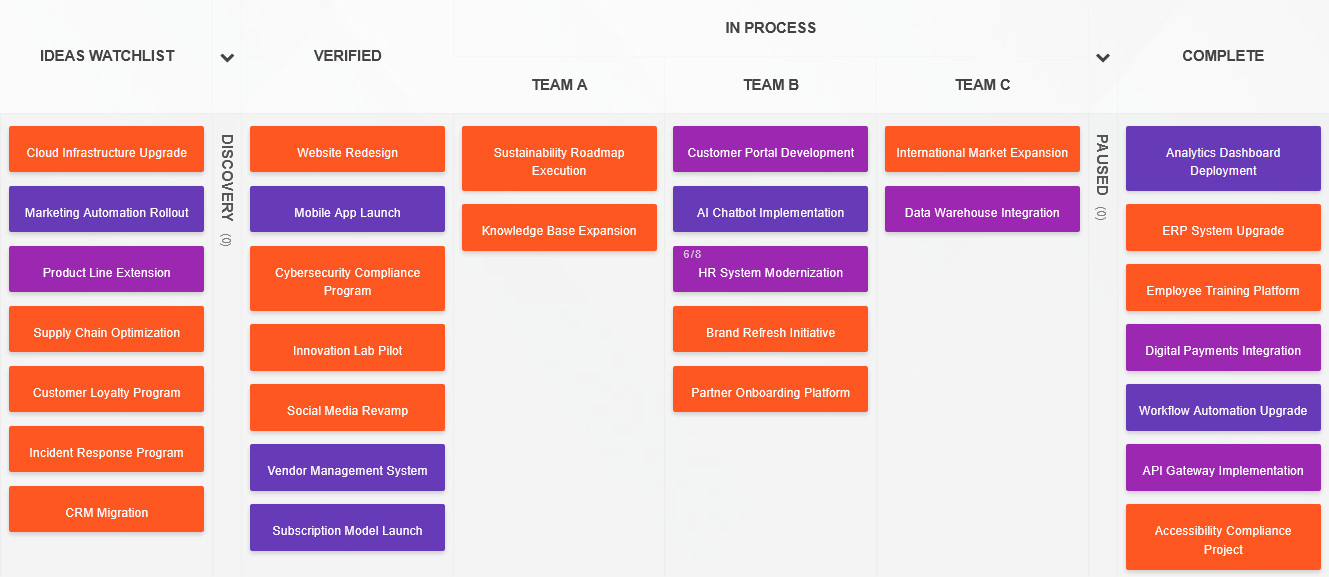
Benefits:
- Visibility across all initiatives.
- Early detection of overloaded areas.
- Possibility to prioritize at the initiative level to minimize scattered team-level firefighting.
2. Discovery Kanban
Many problems stem from unrefined, unclear, or ambiguous work entering team execution boards. An upstream discovery Kanban board allows product managers, analysts, or business owners to refine their ideas before sending them to the delivery teams. Only when an item reaches a clear "Verified" state does it move downstream for execution.
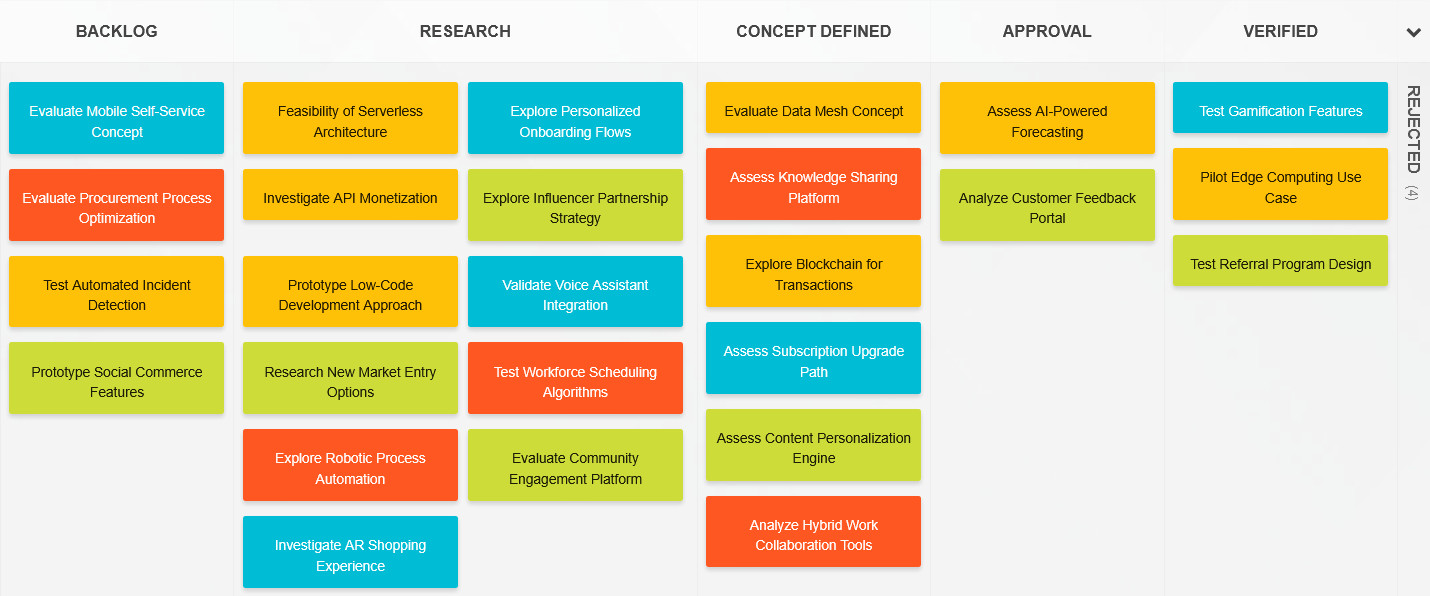
Benefits:
- Reduced waste stemming from processing half-thought-out work.
- A more predictable inflow for teams.
- Encourages maintaining WIP limits at the portfolio and discovery levels.
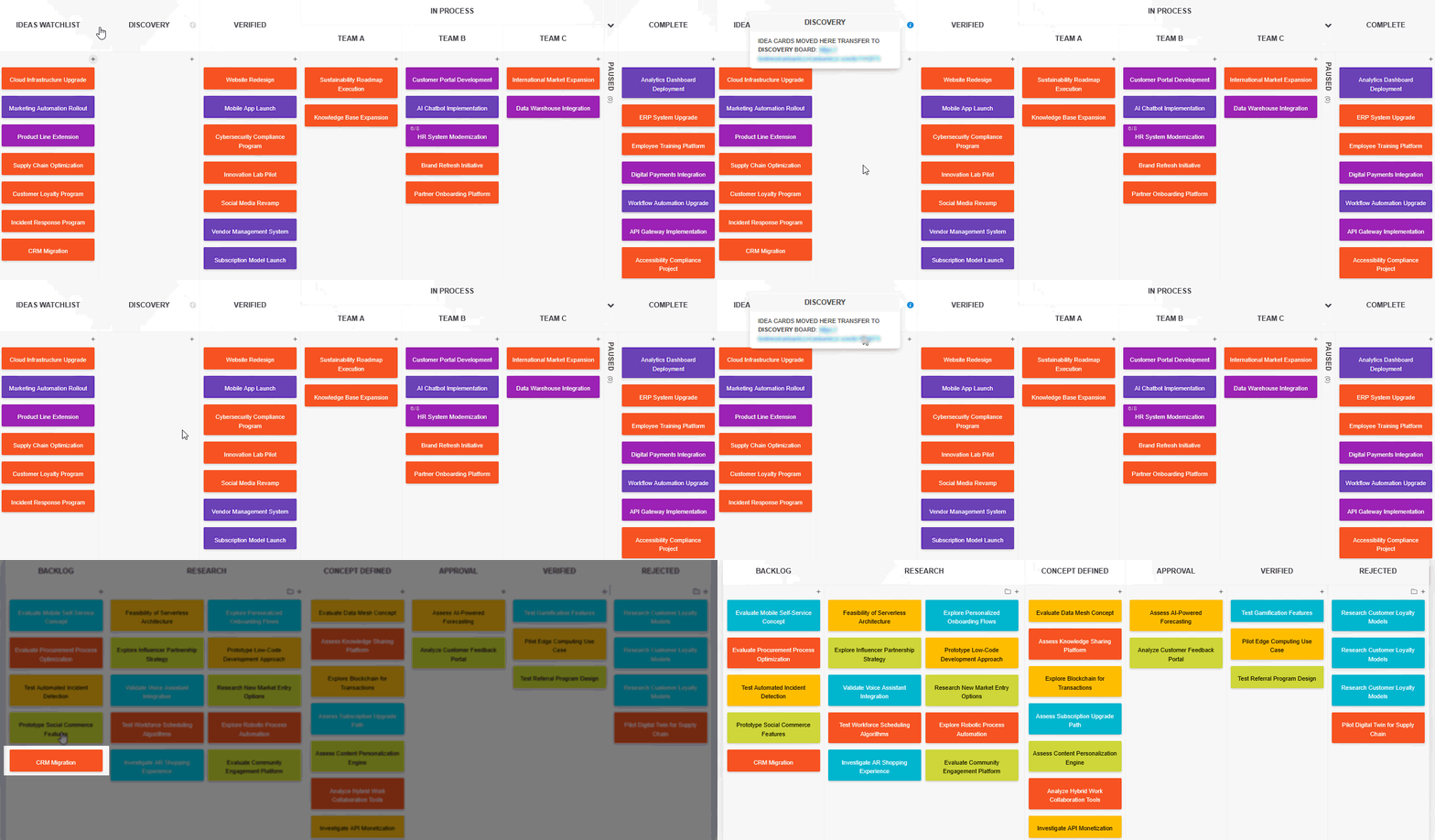
3. Service Kanban
In large organizations, some teams operate as service providers (e.g., infrastructure, compliance, testing). A downstream service board makes team capacity and commitments explicit. Rather than tasking them with ad hoc requests, all involved stakeholders and teams see queued requests, enabling better planning.
4. Dependency marking
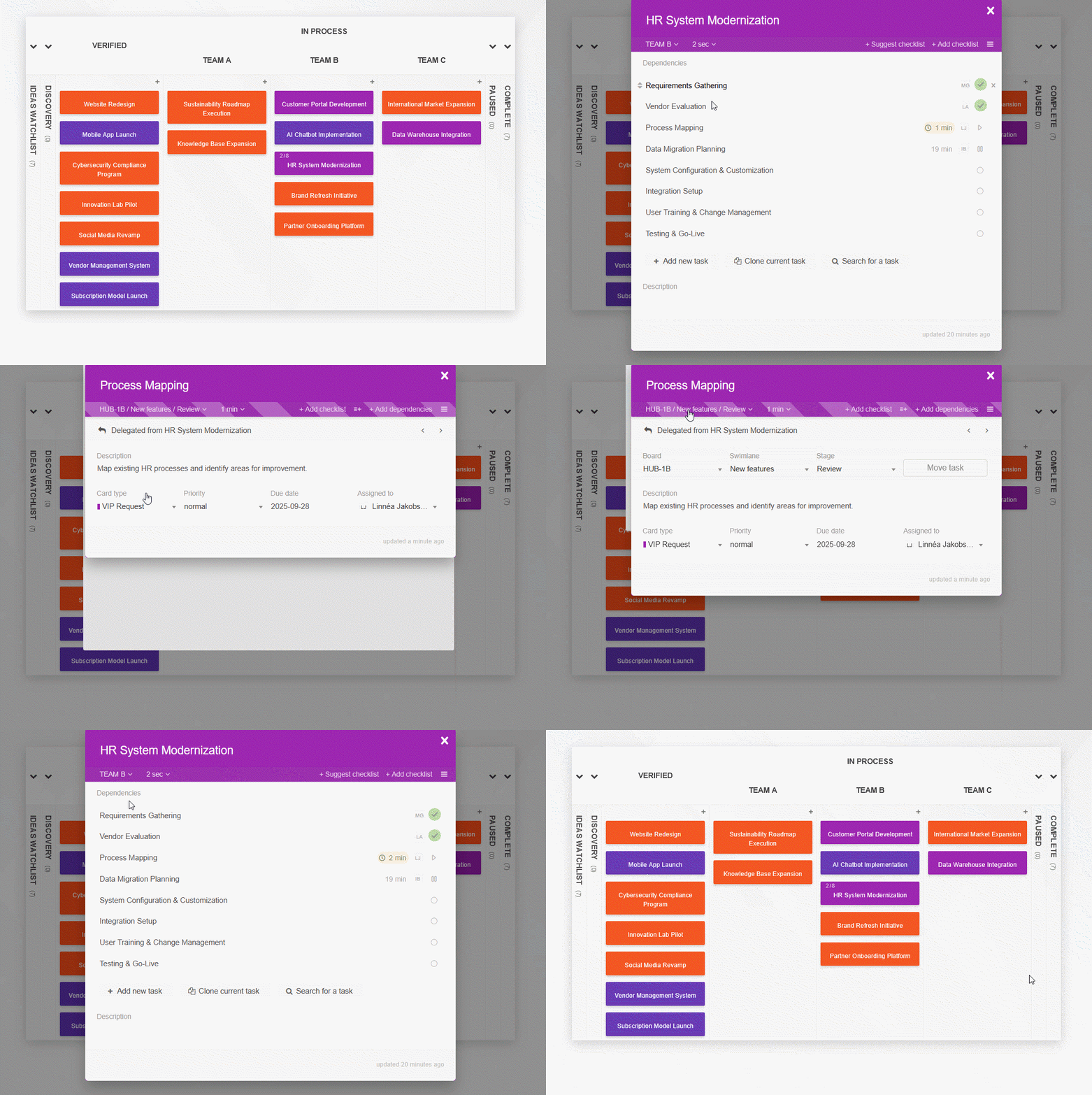
Web services such as Kanban Tool allow tasks on different boards to be directly connected. For example, a feature card on the UX board can be connected to its corresponding development card, reflecting each other's real-time status and thereby maintaining cross-board transparency without the need for central tracking.
Maintaining personal focus
Individuals working across multiple teams or workflows can find the proliferation of boards overwhelming. Which cards belong to me? Which tasks are awaiting my input? Kanban Tool addresses this with two features crucial for multi-team environments:
- My work
It aggregates one's assignments across all boards into a single personal list, constantly sitting on the side of each board. Whether you have to-dos on the marketing board, the product development board, or the QA board, they all appear in one place. This reduces cognitive overhead and eliminates the need to manually patrol each board, without interfering with the boards' flow and order.
- Global search
If dozens of initiatives span multiple boards, finding the relevant task can become a challenge. Global search allows anyone to locate a work item instantly, no matter where it sits. This is crucial for both team members and stakeholders who may not be embedded in a single team, but need speedy access to progress information.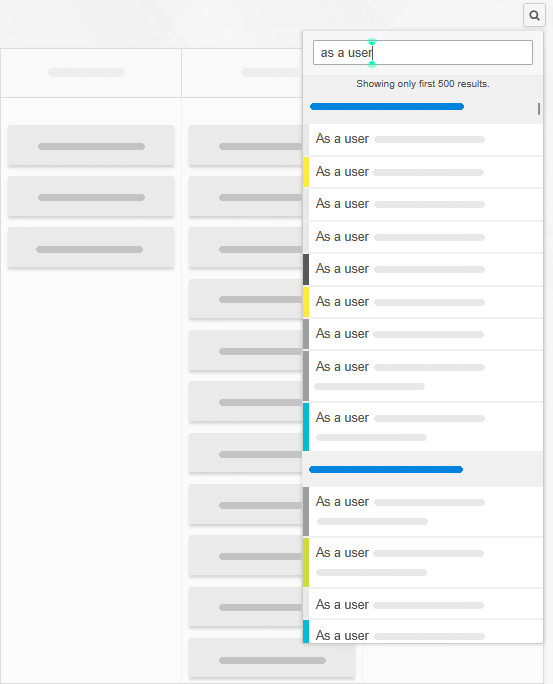
In tandem, these features ensure individuals and stakeholders can navigate project complexity without drowning in it.
Common pitfalls
Even with extensive planning, multi-team Kanban can fail if certain aspects are neglected:
- Overly granular portfolio boards. A portfolio board containing hundreds of items ceases to be strategic. Keep it at the broad initiative level.
- Ignoring WIP limits at higher levels. Portfolio and discovery boards still need explicit WIP limits, just like team boards, otherwise the system stands a risk of pushing everything forward at once. The rules of Kanban should prevail at all levels.
- Misaligned cadences.Teams may hold backlog replenishment and review sessions according to different schedules, leading to mismatched priorities. Some level of synchronized cadence is often necessary for a smooth, coordinated flow.
- Lack of training. Without a shared understanding of Kanban principles, portfolio and discovery boards are often mistaken for traditional project plans, naturally reintroducing command-and-control behaviors foreign to Kanban.
Toward a scaled flow
Scaling Kanban across multiple horizontal and vertical team levels does not mean abandoning its core principles. At its heart, Kanban is about visualizing work, limiting WIP, and explicitly stating policies. What changes in a multi-team environment is the level of abstraction, together with the need for adding clear connective tissue between boards.
Utilizing upstream/downstream flows helps provide systemic visibility, while lightweight synchronization mechanisms such as task dependencies replace large-scale bureaucratic oversight. With the right tools to support them, individuals can remain oriented and focused, even as the system grows.
The result is a network of teams aligned through shared visibility, each preserving autonomy while still contributing to flow at the scale of the organization. Balancing autonomy with alignment is the essence of Kanban in multi-team environments.

Sign up for a 14-day free trial
to test all the features.
Sign up now and see how we can help
your organization deliver exceptional results.
 Český
 Deutsch
 Español
 Française
 Italiano
 Polski
 Português
 Русский